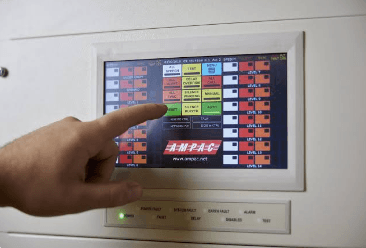
In an emergency, an Emergency Warning and Intercommunication System (EWIS) is the voice that gets people out. It broadcasts the alert and evacuate tones that tell occupants a fire is developing, and it gives wardens and the fire brigade a dedicated network to coordinate a calm, staged evacuation. In a tall building where a fire on one floor may be invisible to everyone else, that voice is the difference between an orderly exit and dangerous confusion.
But an EWIS only saves lives if it actually works when called upon, and that is precisely what EWIS testing exists to guarantee. In Australia, these systems are designed to AS 1670.4 and must be routinely inspected and tested under AS 1851-2012, on a defined cycle, by competent people, with the results documented. This guide explains what an EWIS is, when it’s required, the testing intervals and performance checks involved, who can carry them out, and why getting it right is both a legal obligation and a life-safety imperative.
What is an EWIS?
An Emergency Warning and Intercommunication System (sometimes now called a sound system and intercom system for emergency purposes) is a specialised, monitored fire safety system that alerts building occupants to an emergency and enables coordinated evacuation. It combines two functions: an emergency warning element (standardised alert and evacuate tones and voice messages broadcast over loudspeakers) and an intercommunication element (a dedicated warden phone network independent of the general phone system). The main components:
- Master Emergency Control Panel (MECP): the “brain,” located in the fire control room beside the fire indicator panel (FIP).
- Loudspeakers: broadcast alert/evacuate tones and voice messages; run on 100 V line circuits.
- Warden Intercom Points (WIPs): handsets at warden positions, fire stairs and plant rooms for warden-to-control communication.
- Emergency (white) manual call points: allow manual initiation of warning signals, distinct from red fire MCPs.
- Visual warning devices (strobes): a visual alarm for hearing-impaired occupants and high-noise areas.
- Amplifiers & standby power: drive the speakers and keep the system running on battery backup during mains failure.
When is an EWIS required?
The National Construction Code (NCC) determines when a building needs a full EWIS. As a general rule, an EWIS is mandatory for buildings with an effective height over 25 metres (roughly nine storeys and up), and for certain higher-risk occupancies such as hospitals, aged-care facilities and schools. For these buildings there is typically no simpler alternative: the EWIS is the compliance pathway.
Smaller buildings often instead have a Building Occupant Warning System (BOWS), a simpler occupant-warning arrangement under AS 1670.1 that sounds evacuation signals but lacks the warden intercom network of a full EWIS. Two related distinctions are worth knowing: a standalone public address (PA) system does not satisfy the EWIS requirement (though an EWIS can incorporate PA functions), and lift emergency phones are separate, governed by different standards and not part of the EWIS warden network.
The standards behind EWIS testing
EWIS compliance rests on a small family of standards and the NCC. Design and installation set the benchmark; maintenance keeps the system meeting it:
- NCC (Section E): when an EWIS is required and the performance objective it must meet.
- AS 1670.4: design, installation and commissioning of EWIS (a 2024 edition has been published).
- AS 1670.1: fire detection/alarm design; building occupant warning systems (BOWS).
- AS 1851-2012: routine service (the inspection, testing and maintenance regime for EWIS).
- AS 4428.16 / AS ISO 7240: emergency signal tones and warning-equipment requirements.
- AS 3745-2010: planning for emergencies in facilities (the ECO, wardens and procedures).
In short: design/installation is to AS 1670.4; ongoing testing is to AS 1851-2012. Confirm the applicable AS 1670.4 edition with your fire engineer, and note that AS 1851 compliance became mandatory for essential fire safety measures in NSW from 13 February 2026.
EWIS testing intervals under AS 1851
AS 1851-2012 sets out a tiered routine-service cycle for EWIS (monthly, six-monthly, yearly and five-yearly), with the scope of testing increasing at each longer interval. What each service typically covers (the definitive scope is set out in AS 1851-2012 and the system’s baseline data, so always work to the standard itself):
- Monthly: visual inspection of the MECP and indicators; confirm normal/standby status; check controls and fault indication; functional test of alert and evacuate signals; verify a sample of speakers and WIP communication.
- Six-monthly: as monthly, plus a broader functional test of controls, zones and switching between alert and evacuate signals across the system.
- Yearly: comprehensive functional test of the whole system, covering all zones and speakers, WIP handsets, visual devices, staged-evacuation logic, standby battery performance, and tones verified audible in all areas.
- Five-yearly (the most thorough service): sound pressure level (dB) measurements taken across all areas, full performance verification against baseline, and battery/component condition assessed for replacement.
Many contractors verify tones annually in all areas as a matter of good practice, even where the strict interval differs. Sleeping-risk and high-consequence sites may warrant more frequent checks.
What gets tested: key performance checks
Beyond simply confirming the system switches on, EWIS testing verifies that it will actually be heard and understood, and that wardens can communicate. The critical performance checks:
- Sound pressure level (SPL): the tones must be loud enough to be heard clearly above ambient noise across the building, typically within a 65 to 105 dB(A) working range. Levels are measured and compared to the design/baseline.
- Speech intelligibility (STI): voice messages must be understandable, not just audible. AS 1670.4 sets a minimum Speech Transmission Index (commonly 0.5 STI) where ambient noise is below about 85 dB(A).
- Alert & evacuate tones: both standardised signals are triggered and confirmed correct, distinct, and broadcasting to the right zones.
- WIP communication: each warden intercom handset is tested for clear two-way communication with the MECP.
- Standby power & batteries: the system is verified to run on battery backup for the required duration during a mains failure.
- Staged evacuation logic: phased/sequential warning to different zones is confirmed to operate per the building’s emergency plan.
- Fault monitoring & indicators: the MECP correctly detects and displays faults such as open circuits, speaker line faults and power problems.
The emergency signals: alert and evacuate
EWIS testing hinges on two standardised signals. The alert signal (a slow, measured beep) warns wardens and occupants to prepare, a chance to investigate and ready for evacuation. The evacuate signal (a rising “whoop”) directs immediate evacuation. In a staged evacuation, the alert tone typically sounds on the fire-affected floor first while wardens assess the situation; the system then escalates to the evacuate tone and cascades to adjacent floors (commonly within around ten minutes) so occupants don’t all rush the stairs at once. Testing confirms these signals sound correctly, in the right sequence and zones, and are audible and intelligible throughout.
Who can test an EWIS?
EWIS testing is specialised work and must be performed by competent, appropriately qualified fire technicians. In New South Wales, the practitioner signing off essential fire safety measures for the Annual Fire Safety Statement must hold the relevant FPAS accreditation; other states operate equivalent competency frameworks. Some routine on-site checks (such as monthly warden familiarisation) may involve trained building staff, but the formal AS 1851 inspection, testing and certification must be carried out and signed off by a qualified technician. Given the specialist equipment involved (including an STI meter and SPL meter for intelligibility and sound-level testing), this is not a task for untrained personnel.
Baseline data & record-keeping
Like all fire safety measures, an EWIS is only as good as the records that prove it works. Its baseline data, captured at commissioning, includes the design sound pressure levels, speech-intelligibility results and zone/speaker configuration. Every future test is compared against that baseline to reveal whether performance has drifted (for example, a partition added years later that now blocks a speaker and drops intelligibility below 0.5 STI).
Results must be recorded in the building’s fire safety logbook/asset register, with dates, results against baseline, defects identified and rectified, and the technician’s signature. Those records are the evidence base for the Annual Fire Safety Statement (NSW), the annual Essential Safety Measures report (Victoria) or the equivalent elsewhere. Missing or incomplete EWIS records can invalidate that annual statement, no matter how well the hardware performs. (See our guide to why fire asset registers matter.)
Common EWIS testing failures
Regular testing exists to catch the faults that quietly accumulate in a system that sits idle most of its life. The most common EWIS defects include:
- Dead or noisy WIP handsets: warden phones that don’t connect clearly to the control room.
- Speaker line faults: open or short circuits leaving zones without audible warning.
- Low sound levels or poor intelligibility, often caused by fit-outs, partitions or changed room use since commissioning.
- Failed or aged standby batteries: the system won’t survive a mains failure during an emergency.
- Incorrect zoning or staging: signals broadcasting to the wrong areas or failing to cascade.
- Faulty indicators or fault monitoring: the MECP not correctly reporting problems, masking other defects.
Why EWIS testing matters
- It saves lives: a tested EWIS ensures every occupant hears and understands the warning in time to evacuate safely.
- It’s legally required: routine testing under AS 1851 is mandatory for the essential fire safety measures on a building’s schedule, and underpins the annual compliance statement.
- It protects the occupation certificate: EWIS performance is tied to a building’s certification; a non-compliant system puts that at risk.
- It defends your insurance & liability position: documented testing demonstrates due diligence; gaps can jeopardise claims and expose owners to negligence.
- It catches silent failures: a system used once in a decade can fail invisibly; testing is the only way to know it still works.
EWIS testing best practices
- Follow the full AS 1851 cycle and don’t skip intervals; monthly, six-monthly, yearly and five-yearly each catch different issues.
- Capture and keep baseline data: record commissioning SPL and STI results; you can’t judge drift without a benchmark.
- Test intelligibility, not just volume: a loud but unintelligible message doesn’t help anyone evacuate; measure STI properly.
- Re-test after any building change: fit-outs, partitions and re-purposed rooms can undermine coverage and intelligibility.
- Use accredited technicians: ensure testing and sign-off are done by suitably qualified (e.g. FPAS) practitioners.
- Document everything: log every test, defect and rectification against baseline, ready for audit and the annual statement.
Frequently asked questions
What does EWIS stand for?
EWIS stands for Emergency Warning and Intercommunication System, a fire safety system that broadcasts alert and evacuate signals and gives wardens a dedicated communication network to coordinate evacuation.
How often must an EWIS be tested?
Under AS 1851-2012, EWIS testing follows a tiered cycle: monthly, six-monthly, yearly and five-yearly, with the scope of testing increasing at each longer interval. The five-yearly service includes measuring sound levels across all areas.
What standard governs EWIS in Australia?
EWIS is designed and installed to AS 1670.4 (a 2024 edition has been published), and inspected, tested and maintained under AS 1851-2012. The NCC determines when an EWIS is required.
When is an EWIS required?
The NCC generally requires a full EWIS for buildings over 25 metres effective height, and for certain healthcare, aged-care and school buildings. Smaller buildings may instead use a simpler building occupant warning system (BOWS).
What performance is tested?
Key checks include sound pressure level (typically 65 to 105 dB(A)), speech intelligibility (a minimum of about 0.5 STI under AS 1670.4), correct alert/evacuate tones, WIP communication, standby battery capacity and staged-evacuation logic.
Who can test an EWIS?
A competent, appropriately qualified fire technician (in NSW, one holding the relevant FPAS accreditation for sign-off). Specialist STI and SPL meters are needed for intelligibility and sound-level testing.
Does a PA system count as an EWIS?
No. A standalone public-address system does not satisfy the EWIS requirement, though an EWIS can be designed to include PA functions while preserving the integrity of the life-safety system.
The bottom line
An EWIS is one of the most important life-safety systems in any large building, but it spends almost all of its life silent, which is exactly why disciplined testing matters. Regular inspection and testing under AS 1851 is the only way to know that when the moment comes, the tones will sound, the messages will be understood, and the wardens will be able to talk. It is a legal obligation, an insurance safeguard and, above all, a promise to everyone in the building that they will be warned in time.
If you own or manage a building with an EWIS, make sure it’s on a compliant AS 1851 schedule with an accredited contractor, that baseline data exists, and that every test is documented. The cost of routine testing is trivial next to the cost of a warning system that stays silent when it’s needed most.