Every building has a fire safety story: a network of extinguishers, hydrants, hose reels, sprinklers, detectors, alarms, fire doors and passive barriers quietly standing guard. But if a fire broke out tomorrow, could you prove that every one of those assets was present, correctly located and properly maintained? For a growing number of Australian building owners, the honest answer is “not easily.” That gap is exactly what a fire asset register is designed to close.
A fire asset register is no longer just good housekeeping. As of 13 February 2026, the routine-service standard AS 1851-2012 became a mandatory legal requirement for essential fire safety measures in New South Wales, with other states operating their own equivalent regimes. In practice, that has turned a well-kept register from a nice-to-have into the single most important compliance document most buildings will ever hold. Here’s what a fire asset register is, what it should contain, and why it matters so much for safety, legal compliance, insurance and cost control.
What is a fire asset register?
A fire asset register (sometimes called a fire equipment register, site logbook or asset schedule) is a complete, traceable record of every fire safety asset in a building, together with its details, location, condition and full service history. Think of it as the single source of truth for a building’s fire protection: what you have, where it is, when it was last serviced, whether it passed, and what still needs attention.
At its best, a register is far more than a filing cabinet of paperwork. It is a living dataset that follows the building across its entire lifecycle, linking each physical asset to the inspections, tests and maintenance performed on it. When a technician attends site, the register tells them what to service and how it performed last time. When an auditor or insurer asks a question, the register answers it. And when something changes (an asset is added, moved, upgraded or decommissioned), the register is updated to match reality.
What goes into a fire asset register?
A robust register covers both the active and passive fire safety measures in a building, and captures enough detail about each to identify it, locate it and track its performance over time. The exact contents depend on the building’s fire safety schedule, but typically span these asset categories:
- Portable extinguishers and fire blankets
- Fire hydrants, hose reels and booster assemblies
- Sprinkler systems, pumps, tanks and valves
- Fire detection & alarm systems (FDAS), detectors and EWIS
- Gaseous and kitchen suppression systems
- Fire and smoke doors, dampers and passive firestopping
- Emergency and exit lighting
- Mechanical smoke control and stairwell pressurisation
For each asset, the register should capture enough to identify it and track its performance:
- A unique asset ID / tag number
- Type, make, model and serial number
- Location (level, room, grid reference)
- Installation / commissioning date
- Baseline data and design parameters
- Service intervals and last-service dates
- Inspection results measured against baseline
- Defects raised, rectified and closed out
The register should also record who performed each activity and their competency/accreditation, so every entry is attributable to a qualified person.
The regulatory backbone: AS 1851 and baseline data
In Australia, the routine service of fire protection systems and equipment is governed by AS 1851-2012, the current edition of the standard. AS 1851 sets out, for every category of fire equipment, exactly what must be inspected and tested, how often (monthly, six-monthly, annually or longer), and how results must be recorded. Its record-keeping provisions are what make the asset register a formal deliverable rather than an optional extra.
Central to the standard is the concept of baseline data: the initial reference dataset that represents how a system performed when it was designed and commissioned. Baseline data can include pump performance curves, smoke-detector sensitivities, sprinkler flow figures, hydrant flow and pressure, and EWIS speech intelligibility. Every future service compares the current measurement against that baseline. Without it, there is no way to tell whether a change in performance is normal ageing or a genuine fault developing.
This is why the register and its baseline data are so tightly linked: the register is the structure; the baseline is the benchmark inside it. New buildings should capture baseline data at practical-completion handover; existing buildings should capture it at the next major service. Record-keeping under the standard requires, at minimum, inspection dates, results measured against baseline, defects identified, defects rectified, and the signature of the competent person who did the work.
The 2026 shift: why it matters more than ever
For years, AS 1851 was widely treated as best practice rather than black-letter law. That changed. From 13 February 2026, New South Wales made compliance with AS 1851-2012 mandatory for the essential fire safety measures listed on a building’s fire safety schedule, under the Environmental Planning and Assessment (Development Certification and Fire Safety) Regulation 2021. It applies broadly, from Class 1b through Class 2 to Class 9 buildings, with local councils as the enforcing authority.
The practical effect is significant. Service intervals now run to a defined cycle, defects must be identified and tracked, and the results have to be documented in a compliant on-site logbook. One nuance trips people up: in NSW a hard-copy site logbook is currently still required, and a purely electronic register is not yet permitted to replace it. Digital systems are enormously valuable for managing the data, but for now they run alongside the physical logbook rather than instead of it.
Above all, the reforms sharpened a point of accountability many owners had not fully appreciated: the building owner is responsible for ensuring records are complete and current. You can outsource the maintenance work to a contractor, but you cannot outsource the accountability. If the records aren’t there, it is the owner who wears the consequences.
Seven reasons fire asset registers matter
Strip away the jargon and the value of a well-maintained fire asset register comes down to a handful of powerful, practical benefits.
1. They save lives and protect property
The ultimate purpose is safety. A register ensures every life-safety asset is accounted for and actually working when it is needed most. Gaps in a register are gaps in protection: a missed extinguisher service or an untested detector can be the difference between a contained incident and a catastrophe.
2. They are the foundation of legal compliance
The register is the evidence base for a building’s annual compliance statement: the Annual Fire Safety Statement (AFSS) in NSW, the annual Essential Safety Measures report in Victoria, and equivalent certificates elsewhere. Missing or incomplete records can invalidate that statement entirely, leaving a building non-compliant no matter how well the equipment itself is performing.
3. They protect your insurance position
When a fire causes damage, one of the first things an insurer examines is the maintenance record. A complete register demonstrates due diligence and that assets were serviced to standard. An incomplete one can become grounds to reduce or reject a claim, turning a covered event into an uninsured loss and a dispute that can dwarf the original damage.
4. They make audits and inspections painless
Auditors, certifiers and regulators want proof, fast. In some jurisdictions you may have as little as 24 hours to produce records on request. A current, well-organised register turns a stressful audit into a simple export. A scattered pile of paper dockets turns it into a scramble, and a scramble is where non-conformances are found.
5. They enable smarter, cheaper maintenance
A register is a planning tool as much as a compliance one. It shows what is due and when, preventing both missed services and unnecessary duplicate visits. Over time, the service history reveals which assets fail repeatedly, letting owners budget for replacement before a failure, shifting spend from reactive emergencies to planned, predictable lifecycle management.
6. They preserve knowledge across changes
Buildings change hands, managers move on and contractors are replaced. Without a register, hard-won knowledge about a building’s fire systems walks out the door with them. A good register is institutional memory: a new owner, manager or contractor can pick up exactly where the last left off, baseline data intact.
7. They establish clear accountability
Because every entry is dated and signed by a competent person, a register makes responsibility unambiguous. It records who did what, when, and to what result, protecting owners, managers and contractors alike by creating a defensible, transparent trail.
Fire compliance across the states
While AS 1851 provides the technical foundation nationwide, the way compliance is enforced varies by state. The register underpins the annual mechanism in each:
- NSW: Annual Fire Safety Statement (AFSS), lodged with council and Fire and Rescue NSW and signed by an accredited practitioner (FPAS).
- VIC: annual Essential Safety Measures (ESM) report; the owner maintains ESM records and retains the annual report on site.
- QLD: Occupier’s Statement and records, under the state’s building fire safety obligations.
- Other states/territories: equivalent certificates and records, applying AS 1851 methods and frequencies via local regulation.
Regulatory frameworks change and vary by jurisdiction, so always confirm the current requirements for your state and building class with a suitably accredited fire safety practitioner.
The cost of getting it wrong
Neglecting a fire asset register is a false economy. The downside risks compound quickly:
- Financial penalties: regulators can issue significant fines for failing to maintain compliant records.
- Invalidated statements: an AFSS or ESM report lodged on incomplete records can be rejected, leaving the building non-compliant.
- Insurance disputes: claims can be reduced or denied where maintenance cannot be evidenced.
- Legal & negligence exposure: if an incident occurs, poor records expose owners to liability and negligence claims.
- Reputational damage: compliance failures erode trust with tenants, buyers, insurers and regulators.
The through-line is simple: the equipment can be perfect, but if you can’t prove it, you carry the risk as though it were faulty.
Paper vs digital: the future of the register
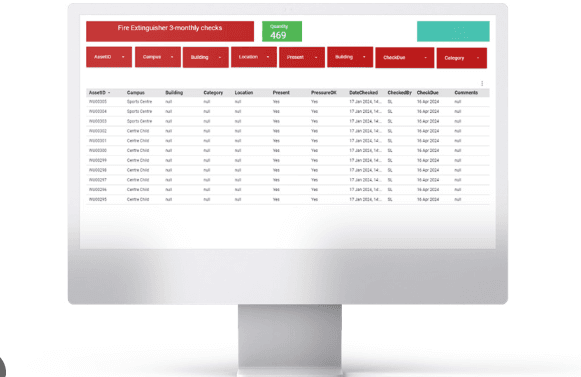
Managing fire asset registers on spreadsheets or in a shoebox of paper dockets is increasingly untenable, especially across multiple properties. As requirements tighten, the risk of gaps, missed services and audit failures grows with every manual step. This is driving rapid adoption of digital fire asset management platforms that give every asset a scannable ID, log services in real time from the field, flag upcoming due dates automatically, and produce audit-ready reports on demand.
The honest caveat: in NSW, digital records currently complement the required on-site hard-copy logbook rather than fully replacing it. So the smart approach today is a hybrid one: use digital tools to manage, schedule and evidence the work with far greater accuracy, while maintaining the physical logbook the regulation still calls for. As standards evolve, expect the digital record to take on an ever-larger formal role.
Best practices for a register you can rely on
- Start now, not at audit time. Building an accurate register takes time; begin collating asset data and closing easy gaps before a deadline forces the issue.
- Capture baseline data early: make baseline capture an explicit deliverable at practical completion, or at the next major service for existing buildings.
- Tag every asset uniquely: a unique ID per asset makes field servicing, tracking and reporting reliable and unambiguous.
- Keep it current: update the register whenever assets are added, moved, upgraded or removed; a stale register is a liability.
- Use accredited people: ensure inspections are performed and signed off by practitioners with the correct competency and accreditation for the category.
- Close out every defect: track each defect, especially critical ones, through to written close-out before relying on any annual statement.
- Retain records properly: keep records for the required period (baseline data for the life of the system) and store them so they’re instantly retrievable.
Frequently asked questions
What is a fire asset register?
It is a complete, traceable record of every fire safety asset in a building (its type, location, condition and full service history), used as the single source of truth for fire protection maintenance and compliance.
Is a fire asset register legally required in Australia?
It is central to compliance. Since 13 February 2026, AS 1851-2012 is mandatory for essential fire safety measures in NSW, and its record-keeping requirements make a compliant register (site logbook) essential. Other states enforce equivalent regimes, so confirm the rules for your jurisdiction.
What is baseline data and why does it matter?
Baseline data is the reference set of performance figures captured at design/commissioning (e.g. pump curves, detector sensitivities, hydrant flow). Every future service is compared against it to tell normal ageing apart from a genuine fault.
Who is responsible for maintaining the register?
The building owner. You can outsource the maintenance work to a fire contractor, but you cannot outsource accountability for keeping records complete and current.
Can I keep my fire asset register digitally?
Digital systems are highly recommended for managing the data, but in NSW they currently complement rather than replace the required hard-copy on-site logbook. A hybrid approach is best practice today.
What happens if my records are incomplete?
You risk fines, a rejected annual fire safety statement, reduced or denied insurance claims, and legal exposure if an incident occurs. Under AS 1851, unrecorded work is treated as work that never happened.
The bottom line
A fire asset register is where fire safety stops being a hope and becomes a fact you can prove. It protects lives, satisfies the law, defends your insurance position, tames audits and turns maintenance from a reactive cost into a managed investment. With AS 1851-2012 now mandatory in NSW and equivalent obligations across the country, the question is no longer whether you need a register, but whether yours is complete, current and ready to stand up to scrutiny.
If there’s any doubt, the best time to fix it is before the next inspection, not during it. Start with an honest asset audit, capture what baseline data you can, close the obvious gaps, and put a system in place to keep it all current.