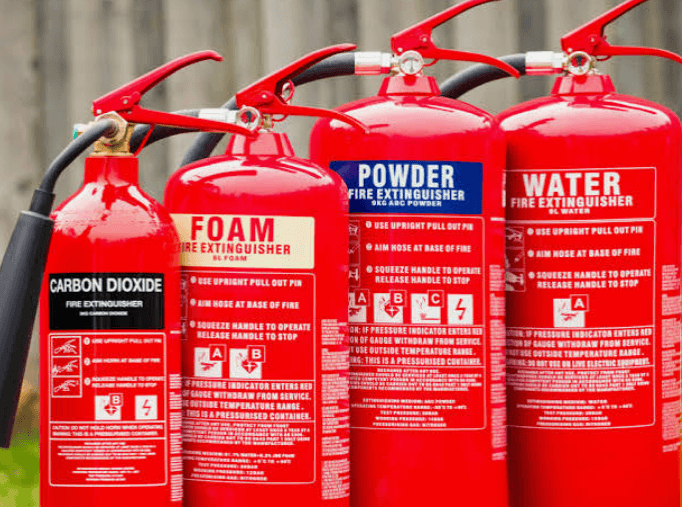
The portable fire extinguisher is the most numerous piece of fire protection equipment in the country, hanging in every office corridor, factory, kitchen, car park and plant room in Australia. It’s also the one piece of equipment that ordinary building occupants are expected to pick up and use in an emergency, often within the first sixty seconds of a fire, when a small incident can still be stopped from becoming a catastrophe.
That only works if the extinguisher works. And whether it works comes down to a servicing regime that is precisely defined in Australian Standards, legally enforceable in every state, and misunderstood by a surprising number of building owners. This is the full breakdown: which standards apply, exactly what happens at the six-monthly, yearly and five-yearly services, the tagging and record-keeping requirements, who’s allowed to do the work, and what it all means for your compliance obligations.
The standards that govern extinguishers
Four Australian Standards do the heavy lifting for portable extinguishers, and it’s worth understanding what each one covers because they’re frequently confused:
- AS 1851-2012: routine service of fire protection systems and equipment. This is the servicing bible: Section 10 specifically covers portable and wheeled fire extinguishers, prescribing the inspection, testing and maintenance activities at each service interval, the pass/fail criteria, and the record-keeping requirements. When anyone talks about “six-monthly extinguisher servicing,” they’re talking about AS 1851 Section 10.
- AS 2444 (portable fire extinguishers and fire blankets: selection and location). This standard determines which extinguishers a building needs and where they go, matching extinguisher types to the fire hazards present, setting distribution and travel-distance requirements, and prescribing mounting heights and signage. The National Construction Code (NCC/BCA) calls up AS 2444 for the provision of extinguishers in class 2 to 9 buildings, which is what makes it enforceable.
- AS/NZS 1841 series: portable fire extinguishers (manufacture). The product standard the extinguisher itself must be manufactured and approved to, with separate parts covering each extinguishing medium. Compliant extinguishers carry certification marking; a cheap online import without it has no place in a commercial building.
- AS 2030 series: gas cylinders. Relevant for carbon dioxide extinguishers, whose high-pressure cylinders are also subject to gas cylinder testing requirements at approved test stations.
On top of the standards sits state legislation. In NSW, extinguishers are typically an essential fire safety measure on a building’s Fire Safety Schedule, meaning their AS 1851 servicing feeds directly into the Annual Fire Safety Statement, and since the reforms that took effect on 13 February 2026, maintaining essential fire safety measures in accordance with AS 1851-2012 is mandatory across class 1b and 2 to 9 buildings, with penalties up to $33,000 for individuals and $66,000 for corporations. Queensland, Victoria and the other jurisdictions impose equivalent obligations through their own building and fire safety regulations, all of them referencing AS 1851 as the servicing benchmark.
Know your extinguisher types (because servicing varies by type)
AS 1851 Section 10 covers all the common extinguishing agents, and while the service intervals are the same across types, some inspection details differ. A quick refresher on the types and the fire classes they’re rated for:
- Water (solid red): Class A fires (ordinary combustibles such as paper, wood and textiles). Dangerous on electrical and flammable liquid fires.
- Foam (blue band): Class A and B (flammable liquids). Not for electrical fires.
- Dry chemical powder ABE (white band), the workhorse: Class A, B and E (electrically energised equipment), and effective on Class C (flammable gases). The most common extinguisher in Australian buildings.
- Dry chemical powder BE: Class B, E and F to a limited degree; common in kitchens and around switchboards in older installations.
- Carbon dioxide / CO₂ (black band): Class E electrical fires and Class B; leaves no residue, which is why it’s standard around server rooms and switchrooms.
- Wet chemical (oatmeal/beige band): Class F (cooking oils and fats); the mandatory choice for commercial kitchens.
- Vaporising liquid (yellow band): clean-agent alternative for electrical and sensitive equipment areas.
Two type-specific servicing wrinkles worth knowing: extinguishers without a pressure gauge (CO₂ and some others) are checked for contents by weighing rather than gauge reading at each service, and CO₂ cylinders follow gas cylinder test station requirements for their periodic pressure testing rather than the workshop process used for stored-pressure units.
The AS 1851 service schedule: what happens and when
AS 1851-2012 prescribes three levels of routine service for portable extinguishers: six-monthly, yearly and five-yearly. Each builds on the one before it. Here’s what actually happens at each.
The six-monthly service
This is the baseline inspection, performed every six months for the life of every extinguisher in the building. The technician works through a defined checklist that includes:
- Location and accessibility: the extinguisher is in its designated location, visible, unobstructed and available for immediate use.
- Signage: the location sign is present, correct and visible.
- Mounting: the bracket or stand is secure and the extinguisher is correctly seated.
- External condition: no corrosion, dents, damage or contamination to the cylinder, and the operating instructions/nameplate are legible.
- Anti-tamper device: the safety pin and tamper seal are intact (a broken seal means the extinguisher may have been discharged and must be treated accordingly).
- Pressure indication: the gauge reads in the operable range; for extinguishers without a gauge (such as CO₂), the unit is weighed and the contents verified against the nameplate.
- Hose and nozzle: present, undamaged and unobstructed.
- Service tag: updated to record the inspection.
Any extinguisher that fails a check is dealt with under AS 1851’s defect regime (more below), and a critical failure (anything meaning the unit could not be relied on to operate) requires immediate action, usually a swap-out with a serviceable unit.
The yearly service
Once every twelve months, one of the two six-monthly visits becomes the yearly service: everything in the six-monthly inspection, plus more detailed examination of the extinguisher’s components (closer inspection of the hose, nozzle and discharge components, the support bracket, and the overall integrity of the unit) against the requirements of the standard. In a well-run maintenance program, the two services land in the same two months each year, six months apart, one recorded as the six-monthly and one as the yearly.
The five-yearly service (the big one)
Every five years, each extinguisher is due for its major overhaul, prescribed in AS 1851-2012. The five-yearly service involves:
- Discharging/emptying the extinguisher completely.
- Dismantling and internal examination of the cylinder, valve and components.
- Hydrostatic pressure testing of the cylinder: pressurising it with water beyond its working pressure to verify the vessel’s integrity. This applies to all portable extinguishers, with CO₂ cylinders tested at an approved gas cylinder test station in line with the AS 2030 framework.
- Recharging with fresh agent and re-pressurising, then refitting, sealing and tagging.
After a successful pressure test, the test date is permanently recorded (stamped or embossed into the cylinder neck or skirt, marked on the service tag, or applied via a tamper-evident durable label), so any future technician can verify the unit’s test history at a glance.
One more rule: if an extinguisher is discharged at any point (used on a fire, let off accidentally, or found with a broken seal and low contents), it must be recharged and, in doing so, effectively restarts its service cycle. Never rehang a used extinguisher and hope it makes it to the next service.
Tags, records, and the paper trail
Extinguisher servicing has the most visible record-keeping system in fire protection: the yellow metal service tag attached to every unit. At each service, the technician stamps or punches the tag with the month and year of the inspection and the level of service performed, historically using a numbered punch where (1) denoted the six-monthly and (2) the yearly service, and the tag also carries the date of the last hydrostatic pressure test. A quick read of the tag tells anyone (owner, auditor or fire brigade officer) when the unit was last serviced and when its five-yearly test falls due.
But the tag is only the on-equipment marker. AS 1851-2012 also requires proper service records: documentation of each routine service, defects found and rectification, retained and available, with records kept for at least seven years and a hard-copy record maintained on site. For a building with dozens or hundreds of extinguishers, an asset register recording each unit’s type, size, location, manufacture date, service history and pressure-test date is essential, and increasingly this lives in digital field-service platforms where each service is time-stamped against the individual asset, making audit evidence and AFSS preparation a matter of minutes rather than a paper chase.
AS 1851 also classifies everything found during servicing into three buckets: a critical defect (renders the unit inoperative, so take immediate action), a non-critical defect (an impairment unlikely to stop the unit working, so rectify promptly), and a non-conformance (a missing or incorrect feature, such as wrong signage, so plan to rectify). Your service reports should show not just the inspections, but how every defect was closed out.
Selection, location, and signage: the AS 2444 layer
Servicing keeps extinguishers working; AS 2444 makes sure the right extinguishers are in the right places, and a technically perfect service regime doesn’t save you if the coverage itself is wrong. The key AS 2444 requirements to understand:
- Type matches hazard. The extinguisher provided must suit the fire classes present in the area: wet chemical near deep fryers, CO₂ or clean agent in switchrooms, ABE for general areas. A water extinguisher next to a commercial cooktop is a non-conformance waiting to be written up (and a hazard).
- Distribution and travel distance: extinguishers must be distributed so that occupants can reach one within the travel distances the standard specifies for the hazard; as a working rule of thumb, in the order of 10 to 15 metres for common applications, with the exact requirement depending on the fire class and risk.
- Mounting height. Extinguishers are mounted so they can be safely lifted off: under AS 2444 the top of the extinguisher sits no more than 1200 mm above floor level, with the base at least 100 mm clear of the floor.
- Signage: each extinguisher requires a location sign mounted above it (positioned high enough, nominally 2 m or more above floor level, to be visible over obstructions and across the space), plus identification signage indicating the extinguisher type and the fire classes it must and must not be used on.
A good servicing provider checks the AS 2444 fundamentals as part of routine visits, because buildings change. Fit-outs relocate walls, new equipment introduces new hazards, and an extinguisher layout that was compliant at occupation can quietly drift out of compliance.
Who is allowed to service extinguishers?
AS 1851-2012 requires routine servicing to be carried out by a competent person: someone with the training, qualification or experience to perform the specific task. In practice, and increasingly in law, that means:
- The national competency benchmark for extinguisher and fire blanket servicing is the unit CPPFES2020 (Inspect and test fire extinguishers and fire blankets) within the fire protection training package, and it underpins the Inspect and Test class of FPA Australia’s FPAS accreditation scheme in the portable fire equipment category.
- In NSW, the post-February-2026 framework requires building owners to ensure maintenance of essential fire safety measures is performed by competent persons, and the assessment of extinguishers as an essential measure for the Annual Fire Safety Statement must be performed by an accredited practitioner (fire safety) holding Fire Safety Assessment accreditation for that measure.
- In Queensland, fire protection work (including extinguisher servicing) requires the appropriate QBCC fire protection occupational licence, regardless of the value of the work.
- The five-yearly service is a workshop function. Hydrostatic testing and recharge require test equipment, filling gear and (for CO₂) an approved gas cylinder test station. This is never a wall-side job, which is why five-yearly units are exchanged or taken away for testing.
The practical takeaway for building owners: ask your provider for evidence of accreditation or licensing in the portable fire equipment category, and record it. “The tag got punched” is not the same as “a competent, accredited person serviced the unit.” (For the full picture of who’s allowed to do what in fire protection, see our guide to Australian fire practitioner accreditations.)
The owner’s quick-reference compliance checklist
Pull this out twice a year, or hand it to whoever manages your maintenance contracts:
- Every extinguisher in the building appears on an asset register with location, type, size and dates.
- Every unit has been serviced in the last six months, with the tag punched and records filed.
- The yearly service is being performed (not just repeated six-monthly checks).
- No unit is past its five-yearly pressure test date (check the tag or cylinder stamp).
- Any discharged or unsealed unit has been recharged or replaced, not rehung.
- Extinguisher types match the hazards in each area (kitchens, switchrooms, plant).
- Mounting heights and location signs comply with AS 2444, and nothing is obstructed.
- All defects from the last service reports are rectified or on a dated plan.
- Service records for at least seven years are retained, with the required hard copy on site.
- Your provider’s accreditation/licence for portable fire equipment is on file.
- Extinguishers are captured on your Fire Safety Schedule / essential safety measures list, and their servicing evidence is ready for your AFSS or annual statement.
- Staff know where extinguishers are and have been trained in their use as part of your AS 3745 emergency planning.
The bottom line
Portable extinguisher compliance is genuinely simple in structure (a six-monthly inspection, a yearly service, and a five-yearly pressure test and overhaul, all prescribed by Section 10 of AS 1851-2012, sitting on top of correct selection and placement under AS 2444), but it’s unforgiving in execution. The obligations attach to every individual unit, the evidence lives on every individual tag and in your service records, and a single forgotten extinguisher past its test date is a defect an auditor will find in thirty seconds.
Get the fundamentals right: a complete asset register, a locked-in six-monthly service cycle with an accredited provider, disciplined defect close-out, and records you can produce on demand. Do that, and the humble red cylinder on the wall does what it was always meant to do: sit quietly for years, then work perfectly in the one minute that matters.