If you design, install or maintain mechanical services in commercial buildings, or you service the smoke control and fire dampers in them, AS 1668 is the standard your work is measured against. It does two big jobs at once: it keeps the air people breathe healthy (ventilation and indoor air quality), and, just as importantly, it controls smoke and air movement when there’s a fire so people can get out safely. Get it wrong and you have a building that’s either stuffy and non-compliant, or unsafe in an emergency. Here’s what AS 1668 actually covers, in plain English.
What is AS 1668?
AS 1668 is the Australian Standard series for the use of ventilation and air conditioning in buildings. It’s referenced by the National Construction Code (NCC), so for most commercial and multi-residential buildings, meeting AS 1668 is how you satisfy the Deemed-to-Satisfy ventilation and smoke-control requirements of the Code. It comes in parts, and the part you reach for depends on whether you’re dealing with everyday air quality or fire-mode smoke control.
The parts of AS 1668
- AS 1668.1: Fire and smoke control in buildings. Covers how mechanical air-handling and dedicated systems control smoke and fire spread in an emergency.
- AS 1668.2: Mechanical ventilation in buildings. Covers the everyday job: supplying enough fresh outdoor air and extracting contaminated air for healthy indoor air quality.
- AS 1668.4: Natural ventilation of buildings. Covers meeting ventilation requirements using openings and natural airflow rather than fans.
The NCC calls up specific editions (broadly, AS 1668.1:2015 and AS 1668.2:2012), and a newer 2024 edition of Part 2 has since been published, so always check which edition the current NCC actually references for your project.
AS 1668.2: mechanical ventilation and indoor air quality
AS 1668.2 is the part that governs indoor air quality. It sets out when mechanical ventilation is required and how much air you have to move to keep a space healthy and comfortable. In broad terms it covers:
- Minimum outdoor-air supply rates: set per person and per floor area for each type of room or use, so occupants get enough fresh air.
- Exhaust of contaminated air from bathrooms, toilets, kitchens, laboratories and other spaces that generate odours, moisture or fumes.
- Enclosed car park ventilation, often with carbon-monoxide (CO) monitoring that ramps the fans up and down to keep CO below safe limits.
- Make-up air: replacing the air you exhaust so the building isn’t starved or unbalanced.
- Control of specific contaminants: capturing fumes and pollutants at the source where needed.
Done properly, AS 1668.2 is what stops a building feeling stuffy, humid or stale, and keeps pollutants and CO₂ at levels that don’t harm health or concentration.
Why indoor air quality matters
Indoor air quality (IAQ) has climbed up everyone’s priority list, partly because we spend most of our day indoors, and partly because building occupants now expect healthy air as standard. Good ventilation under AS 1668.2 delivers:
- Health: diluting CO₂, airborne contaminants and the spread of airborne illness.
- Comfort and productivity: stale, high-CO₂ air makes people drowsy and unfocused.
- Compliance: undersized or poorly maintained ventilation can breach the NCC.
- An energy balance: ventilation has an energy cost, so the design has to bring in enough fresh air without needlessly wasting conditioned air.
AS 1668.1: fire and smoke control
AS 1668.1 is the fire-safety half of the standard. In a fire, smoke (not flame) is what kills and what stops people escaping. AS 1668.1 sets out how a building’s air systems manage that smoke, through measures such as:
- Air-handling fire mode: shutting down or switching normal HVAC to a fire mode so it doesn’t pump smoke through the building.
- Smoke exhaust / smoke spill systems: actively drawing smoke out of the fire zone.
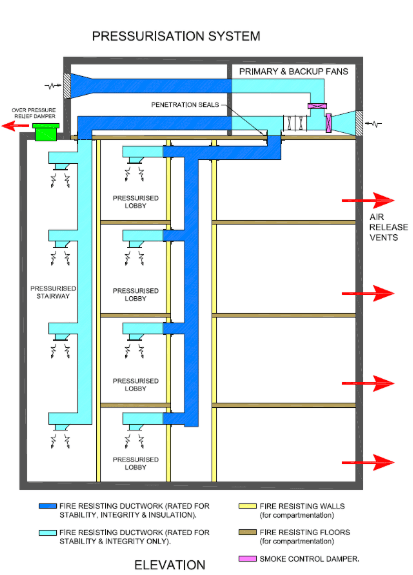
- Stair and lift-shaft pressurisation: keeping fire stairs and lift shafts at higher pressure so smoke can’t enter the escape route.
- Zone smoke control: using pressure differences to keep smoke contained to the floor or zone where the fire is.
- Fire and smoke dampers: automatic dampers in ductwork that close to stop fire and smoke crossing fire-rated boundaries.
The goal is simple: keep the paths of travel and exits tenable long enough for everyone to get out, and stop smoke spreading through the building’s ductwork.
AS 1668.4: natural ventilation
Not every space needs fans. AS 1668.4 sets out how to meet ventilation requirements using natural airflow (permanent openings, windows and the like) sized so the space gets enough fresh air without a mechanical system. It’s common in naturally ventilated areas and where designers want to reduce mechanical plant and running costs.
How AS 1668 fits the National Construction Code
AS 1668 doesn’t apply on its own. It’s pulled in by the NCC. The simplest compliance path (Deemed-to-Satisfy) is to design ventilation and smoke control directly to AS 1668. Alternatively, a building can use a Performance Solution (an engineered design verified against the NCC’s performance requirements), which still typically uses AS 1668 as the benchmark. Either way, the standard is the reference point a certifier checks against.
Where AS 1668 meets fire-safety compliance
This is the part building owners and HVAC contractors can’t afford to miss. The fire-mode and smoke-control systems designed under AS 1668.1 (air-handling fire mode, smoke exhaust, stair pressurisation, fire and smoke dampers) are essential fire safety measures. That means once the building is occupied they have to be routinely serviced (under AS 1851) and, in NSW, certified each year in the building’s Annual Fire Safety Statement (AFSS). A mechanical ventilation system isn’t just a comfort item. Part of it is life-safety equipment with ongoing legal obligations attached.
Commissioning, testing and maintenance
AS 1668 systems have to be commissioned to prove they perform as designed, then kept performing for the life of the building. Typical ongoing work includes:
- Verifying outdoor-air and exhaust rates against the design (air balancing).
- Testing fire-mode operation, checking that normal HVAC switches correctly into fire mode on alarm.
- Drop-testing fire and smoke dampers so they actually close.
- Testing stair and shaft pressurisation to confirm the pressure and airflow.
- Checking and calibrating car park CO monitoring.
- Routine filter changes, coil cleaning and fan maintenance to keep IAQ and airflow up.
Common pitfalls
- Treating ventilation as “set and forget”. IAQ and fire-mode performance both degrade without maintenance.
- Forgetting that smoke-control HVAC is an essential fire safety measure with AS 1851 servicing and AFSS obligations.
- Working to the wrong edition of the standard. Confirm which AS 1668 edition the current NCC references.
- Building changes (new walls, changed room use, higher occupancy) that quietly make the existing ventilation undersized.
- Dampers and pressurisation systems that were commissioned once and never re-tested.