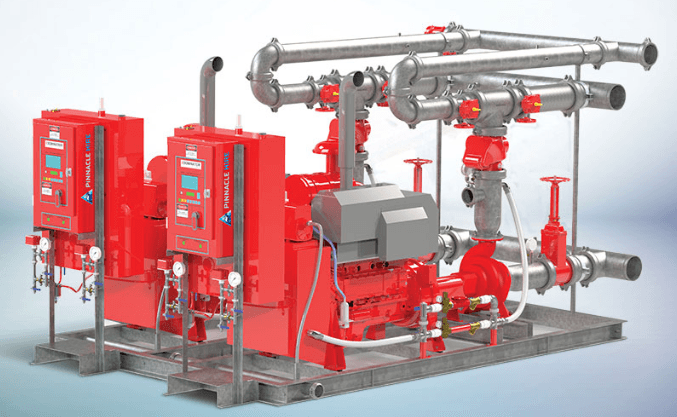
When a hydrant or sprinkler system needs more pressure or flow than the town main can give, a fire pumpset makes up the difference. It sits in a plant room for years doing nothing, and then it has to start first time, run without supervision and deliver its design performance for as long as the fire brigade needs it. Routine servicing is the only way anyone knows whether it will.
Fire pumpsets have their own section in AS 1851-2012 (Section 3), and they carry some of the most important readings in the whole standard. Their flow and pressure performance is one of the few areas where AS 1851 requires baseline data. A pump left in manual, a closed valve or a flat battery bank can quietly disable the system it serves.
This guide explains how electric and diesel pumpsets differ, the service frequencies and tolerances, how to run a monthly start test, how annual flow testing works, where pressure maintenance pumps fit in, which findings are critical defects, and what to record.
What a fire pumpset is
A fire pumpset is more than a pump. Pumpsets are designed and installed to AS 2941, and the “set” is the whole assembly that has to work together:
- The pump: typically a centrifugal pump sized to a duty point, a flow at a pressure the system’s design requires.
- The driver: an electric motor or a diesel engine.
- The controller, which senses a drop in system pressure, starts the pump automatically and reports its status.
- Suction and discharge isolating valves, which must be secured open in service.
- Pressure gauges and pressure switches or transducers, which tell the controller when to start.
- A circulation relief arrangement, which passes a small flow to keep the pump from overheating when it runs against a closed system.
- A test and flow-measurement arrangement, so the pump’s actual performance can be measured.
- Usually a pressure maintenance pump (often called a jockey or jacking pump), which tops up minor pressure losses so the main pump doesn’t start for every small leak.
Pumpsets serve hydrant systems, sprinkler systems and combined systems, drawing from the town main, storage tanks or both. Knowing what the pump serves, and where its water comes from, matters as much as the pump itself.
Electric vs diesel pumpsets
Many buildings have one of each: an electric pump as the duty pump and a diesel as the standby, so the system still works if the power fails. They need the same outcome from servicing (start automatically, run reliably, deliver the duty point), but they fail in different ways, so the checks differ.
| Electric pumpset | Diesel pumpset | |
|---|---|---|
| Energy source | The building’s electrical supply, through a dedicated fire-rated supply to the controller | A diesel engine with its own fuel supply, independent of mains power |
| Starting | The controller starts the motor on a drop in system pressure | The controller cranks the engine from its batteries on a drop in system pressure; diesel pumpsets are fitted with duplicated batteries and chargers so one failure doesn’t stop the start |
| Stopping | Once started automatically, it keeps running until someone stops it manually | Once started automatically, it keeps running until someone stops it manually at the pumpset |
| What usually goes wrong | Supply isolated or tripped, controller left in manual or off, phase failure, motor or bearing wear | Flat or failed batteries, charger faults, fuel low or degraded, cooling water or coolant problems, leaks, controller left in manual or off |
| Extra things to check | Supply available at the controller, isolator secured on, phase and supply indications | Fuel level and condition, both battery banks and both chargers, lubricating oil and coolant, cooling water discharge, belts, hoses, exhaust and leaks |
Frequencies and tolerances
AS 1851-2012 sets out the routine service activities for fire pumpsets in Section 3, at the intervals below. The tolerances (how far either side of the scheduled date the activity can be carried out) come from Table 1.11(B), as summarised in Building Commission NSW’s good practice guide:
| Interval | Tolerance | Notes |
|---|---|---|
| Monthly | ± 5 working days | The routine start and run test |
| Six-monthly | ± 1 month | |
| Yearly | ± 2 months | Includes the annual performance (flow) test |
| Two-yearly | ± 2 months | Replace diesel engine start batteries irrespective of condition, and record the date on the battery and in the site records (Table 3.4.3, item 3.5) |
| Five-yearly | ± 3 months | Repack pump glands; overhaul circulation-relief, pressure-relief, engine cooling and pressure-regulating valves; repack stop valves; check ball and butterfly valves are holding (Table 3.4.4) |
The exact activities for each interval are in the Section 3 tables of the standard, and each is recorded as a pass or fail in the logbook against its section and interval. A service carried out outside its tolerance is an out of tolerance activity: it’s recorded in the logbook as a non-conformance, and the service is carried out as soon as practical.
The standard itself is the reference. Buy a current copy, check which amendments you’re working to, and make sure your task sheets list the activities the Section 3 tables actually require, not what the last contractor’s checklist happened to include.
The monthly start test
The monthly test proves the most important thing a fire pump does: start by itself when system pressure drops. Starting the pump with a button proves the motor or engine works. It doesn’t prove the pressure switch, the controller and the start circuit will work in a fire.
Before you start
- Tell the building. A running fire pump is loud, and a pump-run signal may be monitored or show on the fire panel, so let the building manager, and the monitoring provider if the signal goes off site, know what you’re doing.
- Check the controller is in automatic, and note any alarms or fault indications before you touch anything.
- Check the suction and discharge valves are open and secured.
- Record the standing system pressure and the pressure maintenance pump’s behaviour.
- For diesel: check fuel level, oil and coolant, and that both battery chargers show normal.
Running the test
- Simulate demand by lowering pressure at the pressure switch (typically by opening its test or drain valve) so the controller starts the pump on falling pressure, just as it would in a fire.
- Record the pressure at which the pump started: the cut-in pressure.
- For a diesel, confirm the engine can start from each battery bank.
- Let the pump run for the period the standard and the manufacturer specify, long enough for pressures and temperatures to settle.
- While it runs, record suction and discharge pressure, speed, and for a diesel the engine temperature, oil pressure and charging.
- Look and listen: unusual noise or vibration, overheating, leaks, gland leakage outside the normal range (packed glands are meant to drip), and cooling water discharging where it should.
- Check the circulation relief is discharging so the pump isn’t overheating against a closed system.
- Stop the pump manually, then return the controller to automatic.
Before you leave
- Confirm the controller is back in automatic and the valves are secured open. A pump left in manual is a disabled fire system.
- For a diesel, check the fuel level after the run and top up or report it.
- Record the results in the pumpset’s logbook, and note any defect with its classification.
Annual performance and flow testing
The monthly test proves the pump starts and runs. The annual test proves it still delivers: the flow and pressure the system was designed to rely on. This is where baseline data matters.
Under clause 1.8 of AS 1851-2012, baseline data is limited to what the approved design required and what’s needed to verify a routine service result. Building Commission NSW’s guide says the only routine service activities it applies to are the flow and pressure performance data for sprinkler systems, hydrant systems, fire pumpsets and some mechanical service features. For a pumpset, that performance benchmark usually comes from:
- The pump’s rated duty point (its flow at a pressure) on the data plate.
- The manufacturer’s performance curve for that pump, impeller and speed.
- The commissioning test results for the installed pumpset.
- The block plan and hydraulic data for the system it serves.
What to measure
- Churn, or no-flow, pressure: what the pump produces running against a closed discharge.
- Flow and pressure at the duty point, measured through the test and flow-measurement arrangement.
- Suction pressure throughout, so you can tell a pump problem from a water supply problem.
- Speed, and for a diesel the engine’s behaviour under load.
Plot the results against the performance curve and last year’s results. A pump that produces less pressure at the same flow than it used to is telling you something: worn impeller or wear rings, a partially closed valve, a blockage, or a speed problem. A falling suction pressure points back to the water supply.
Where the baseline data isn’t available, AS 1851-2012 is clear: carry out the test, record and report the result, and record and report the missing baseline data as a non-conformance. Don’t adopt this year’s result as the new baseline, because a reading from a worn pump would lock in the wear.
Flow testing discharges a lot of water. Plan where it goes, whether it can be recirculated to a tank, who needs to be told, and whether the water authority or site has any conditions. Do this before the day, not on it.
Planning the annual test
- Book it with the building well ahead. It takes longer than a monthly test, it’s loud, and the pump-run signal may need managing with the monitoring provider.
- Have the baseline ready (data plate details, performance curve, commissioning results and last year’s readings) so you can compare on the day, not back at the office.
- Plan the water: where it discharges, whether it can return to a tank, and any site or water authority conditions.
- Coordinate with the water supply proving tests for the systems the pump serves, so you understand the whole supply and not just the pump.
- Allow time to investigate. If the pump is well off its curve, you want to find out why while you’re still on site.
- After a pumpset is replaced or significantly repaired, consider an independent witness. In Building Commission NSW’s case study, the owners had the post-commissioning water supply proving test independently witnessed to be sure they were getting a correctly performing pumpset.
Pressure maintenance pumps
The pressure maintenance pump keeps the system topped up so that small losses (a weeping valve, a minor leak, temperature changes) don’t start the main pump. It starts at a higher pressure than the main pump, so it acts first.
- Check and record its start and stop pressures, and make sure they sit properly above the main pump’s cut-in.
- Watch how often it cycles. A jockey pump starting frequently usually means a leak somewhere in the system. Find it and report it.
- If the main pump starts before the jockey pump, the pressure settings are wrong and the system is working the main pump for every small loss.
Critical defects in the pump room
A critical defect is one that has rendered the system inoperable and is reasonably likely to have a significant adverse impact on the safety of occupants in a fire. Because a pumpset is often the only way a hydrant or sprinkler system can reach its design performance, a pumpset failure frequently meets that test. Findings that commonly do:
- The pump doesn’t start automatically on falling pressure.
- The controller has been left in manual or off.
- A suction or discharge valve is closed, or the pump’s water supply is isolated.
- A diesel won’t start, or can’t start from its batteries, or has no usable fuel.
- The electric supply to an electric pumpset is isolated or has failed.
- The pump can’t deliver the flow and pressure the system relies on.
A critical defect must be reported to the building owner or their nominated representative before you leave site, or as soon as possible, and confirmed in writing within 24 hours. Lower-order issues, such as a gauge that needs replacing or a missing label, are generally non-critical defects or non-conformances, notified within one week. Classify on the evidence, and record why.
What to record
| Reading | Why it matters |
|---|---|
| Standing system pressure | The starting point for the test, and a check on the pressure maintenance pump |
| Cut-in pressure | Proves the automatic start works at the right pressure |
| Suction and discharge pressure while running | Separates pump performance from water supply performance |
| Churn (no-flow) pressure | A quick annual indicator of pump condition |
| Flow and pressure at the duty point | The core evidence the pump still meets its design |
| Speed | Performance depends on it; a slow driver means low output |
| Diesel engine readings | Temperature, oil pressure, charging, fuel level and battery condition |
| Jockey pump start and stop pressures | Correct sequencing, and early warning of leaks |
| Controller mode on departure | Proof the pump was left in automatic |
Keep the readings against the pumpset itself, year after year. A single test result is a pass or fail; five years of results side by side show a pump wearing out before it fails.
Taking over a pump room
On the first visit to a new site, spend a few extra minutes building the pumpset’s record:
- Photograph every data plate (pump, motor or engine, and controller) and note the model and serial numbers.
- Record the controller settings and the start and stop pressures of the main and pressure maintenance pumps.
- Find the performance curve, the commissioning sheet and the block plan, or record them as missing.
- For a diesel, note the age of the batteries, the fuel quantity and any fuel maintenance records.
- Read the previous logbooks for recurring faults, and look at the trend in past flow results.
- Note what the pump serves and where its water comes from.
Working safely
- Rotating equipment: keep guards in place and never reach near a coupling that could start automatically.
- A pump can start without warning while the controller is in automatic, so treat it as live.
- Diesel exhaust and heat: make sure the pump room is ventilated and the exhaust discharges outside.
- Noise: hearing protection during run tests.
- Water under pressure: control discharges and check test outlets and hoses are secured.
- Isolations: if a pumpset has to come out of service, tell the building owner, record it, and restore it before you leave.
Common mistakes
- Starting the pump with the manual button and calling it an automatic start test.
- Leaving the controller in manual after the test.
- Testing only one battery bank on a diesel.
- Recording a flow result without the pressure it was measured at.
- Treating this year’s flow result as the baseline.
- Ignoring a jockey pump that cycles constantly.
- Recording readings on paper that never gets compared with last year’s.
Frequently asked questions
How often do fire pumps need to be tested under AS 1851?
AS 1851-2012 sets monthly, six-monthly, yearly, two-yearly and five-yearly routine service activities for fire pumpsets. The monthly tolerance is five working days either side of the scheduled date.
Should the monthly test start the pump automatically?
Yes. Lowering pressure at the pressure switch so the controller starts the pump proves the whole start circuit works. A manual start only proves the driver runs.
Why doesn’t the fire pump stop when pressure is restored?
Fire pumps are designed to keep running once started automatically, so they can’t shut themselves down during a fire. They’re stopped manually.
What if there’s no pump curve or commissioning data?
Carry out the test and record the results, and record and report the missing baseline data as a non-conformance. The data plate, the manufacturer and the original installer are the first places to look for the curve.
Is a pump left in manual a critical defect?
Usually. If the pump can’t start automatically when the system needs it, the system it serves may not perform in a fire. Tell the responsible entity before you leave and confirm it in writing within 24 hours.
Does replacing a fire pumpset need approval?
It can. In Building Commission NSW’s case study, a like-for-like replacement still required council approval. Check before committing to the work.
Sources and further reading
- Good practice guide for the inspection, testing, maintenance and repair of fire protection systems in NSW buildings, Building Commission NSW (January 2026)
- Building fire safety requirements under AS 1851-2012, Building Commission NSW
- FSG-05 Maintenance of fire protection systems and equipment, ACT Fire & Rescue (August 2023)
- AS 1851-2012 post-annual servicing requirements, Fire Protection Association Australia