There is a compliance obligation sitting on most fire services that has nothing to do with AS 1851, runs on its own annual clock, is enforced by a completely different body, and is routinely missed because neither the fire contractor nor the plumber believes it belongs to them.
It is the backflow prevention device on the water supply to the hydrant or sprinkler service. It has to be tested every year by an accredited tester, the result has to be lodged with the water authority, and the building owner carries the consequence when it is not. Most owners have no idea it exists until a notice arrives.
This guide explains why fire services create a contamination risk in the first place, how hazard rating decides which device is fitted, who is legally allowed to test one, what the annual test involves, how lodgement works, the isolation traps unique to fire systems, and how to handle the whole thing commercially without either absorbing somebody else scope or leaving a client exposed.
Why a fire service is a contamination risk
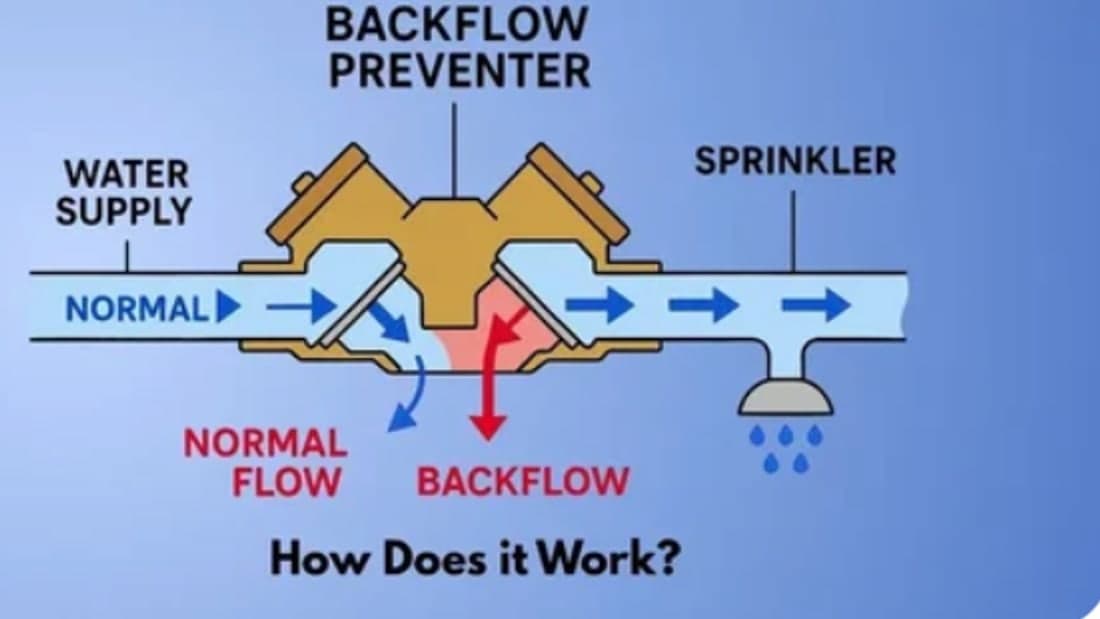
Drinking water is supplied under pressure, and the assumption underneath every water network is that it flows one way. Backflow is what happens when that assumption fails: a pressure drop in the main, or pressure in the building higher than the main, pulls or pushes water from the property back into the public supply.
Fire services are a classic case because of what sits in them:
- Water that has been standing still in steel pipework for years, with the corrosion products and bacterial growth that come with it.
- Stored water tanks, which are open systems with their own contamination profile.
- Additives in some systems: antifreeze, corrosion inhibitors, wetting agents or foam concentrate.
- Booster connections, where a fire appliance can pump water from an unknown source into the building service at pressure well above the main.
- Cross connections created during works, where a fire service and another system are temporarily joined.
The booster case is the one that makes water authorities nervous. A pumping appliance drafting from a river, a swimming pool or a tanker and boosting into the building can put non-potable water into a service connected to the town main. That single scenario is why fire services are so often required to carry a testable device.
Hazard rating decides the device
Backflow protection is proportionate to risk. The water authority assigns a hazard rating to the connection, and that rating determines the device.
| Hazard rating | What it means | Typical device | Testable? |
|---|---|---|---|
| High | Backflow could cause illness or death | Reduced pressure zone device (RPZD), registered air gap or break tank | Yes, annually |
| Medium | Backflow could cause illness or objectionable water | Double check valve assembly (DCV) or RPZD | Yes, annually |
| Low | Nuisance only | Dual check valve | Generally not testable |
For fire services the common outcome is a medium hazard rating with a double check valve where the system holds nothing but town water and has no capacity to introduce anything else, and a high hazard rating with a reduced pressure zone device where there is a tank, additives, an alternative supply or a booster arrangement that could admit water from an unknown source. The authority makes that call, not the contractor, and it can change when the building changes.
Inside the device: what a DCV and an RPZ actually do
It is worth understanding the mechanism, because the failure modes and the test procedure both follow directly from it, and because explaining it well is often what convinces an owner to fund a repair.
Double check valve assembly
A double check valve is two independent spring-loaded check valves in series, with isolation valves either side and test cocks between them. Each check valve is designed to hold against a small reverse differential on its own. The protection is redundancy: for backflow to occur, both check valves have to fail at once. The annual test is therefore a test of each check valve separately, which is why the test cocks exist and why a single reading across the whole assembly proves nothing.
Reduced pressure zone device
An RPZ adds a third element between the two check valves: a relief valve that vents the zone between them to atmosphere. It is held shut by the pressure differential across the first check valve. If the first check valve leaks, or supply pressure falls, the differential collapses and the relief valve opens, dumping the intermediate zone to the drain rather than allowing anything to pass back upstream. That is what makes it suitable for high hazard connections, and it is also why it needs a drain capable of taking a full discharge, not a tundish that will overflow into a pump room.
Two practical consequences of the mechanism are worth carrying to site. First, an RPZ that is discharging is not necessarily broken; it may be doing exactly what it is designed to do because supply pressure is fluctuating or the first check is fouled. Either way it needs investigation rather than a bucket. Second, both devices impose a permanent head loss on the service, and the RPZ imposes more, which is the fire contractor concern rather than the plumber one.
Tanks, air gaps and the service with no device at all
Not every fire service is protected by a testable valve assembly. Where a building has a stored water tank fed through a registered air gap, the air gap itself is the backflow protection: water falls through open air into the tank, and nothing in the tank can travel back up the inlet. There is no device to test, but there is still something to inspect, and it fails in predictable ways.
- The gap itself has been reduced, usually by an inlet pipe being extended, dropped or re-supported closer to the water line.
- The tank overflow is undersized, blocked or discharges somewhere that backs up, which can submerge the inlet under fault conditions.
- A later connection has been made downstream of the tank that bypasses the air gap entirely.
- The tank is open to contamination: missing or damaged lids, failed insect screens, or roof water finding its way in.
None of that appears on a backflow test report, because there is nothing to attach a gauge to. It appears in your inspection report, or it appears nowhere. When you are surveying a building, record how the supply is protected as a fact about the system, whether that is a device with a serial number or an air gap with a measurement, so that next year somebody knows what they are looking at.
The standards and who enforces them
- AS 2845.1 sets the materials, design and performance requirements for backflow prevention devices.
- AS/NZS 3500.1 covers water services, including where and how devices are installed.
- Field testing follows the requirements published by the water authority for the area, which generally align with the AS 2845 series.
- The obligation itself is imposed by the water authority under its own operating licence and customer contract, not by AS 1851 and not by the NCC.
That last point is the reason this gets missed. Every other clock on a fire service runs through the building surveyor, the council or the standard. This one runs through the water utility: Sydney Water, Hunter Water, the Victorian retailers, Urban Utilities, SA Water, Water Corporation, TasWater, Icon Water, Power and Water, or the local council where a council is the water supplier. Their requirements differ in the detail, particularly on lodgement, so check the one that applies rather than assuming a national rule.
Who is allowed to test one
Backflow testing is plumbing work carried out by a licensed plumber holding a current backflow prevention accreditation, and in most jurisdictions the tester must also be registered with the relevant water authority before their test reports will be accepted.
A fire protection technician, however experienced, is not automatically entitled to test a backflow device. This is one of the sharper scope boundaries in the industry, and it catches contractors who assume that because the device sits on the fire service, it belongs to the fire service contract. The three workable options are:
- Have a licensed plumber on staff obtain and maintain backflow accreditation, and register them with the authorities you work under.
- Subcontract the testing to an accredited tester and coordinate it with your AS 1851 visit, carrying the coordination in your fee.
- Exclude it explicitly from your scope in writing, and tell the owner in your report that the obligation exists and sits outside your contract.
All three are defensible. What is not defensible is silence: an owner who finds out about an untested device from an authority notice will reasonably ask why their fire contractor never mentioned it.
What the annual test involves
- Plan the isolation. On a fire service this is an impairment, and it has to be treated as one.
- Notify: the building manager, the monitoring provider and, where required, the fire brigade or the authority, before any valve is closed.
- Isolate the device and fit the test kit to the test cocks.
- Test each check valve for tightness against the differential the standard requires, and on an RPZ, test the relief valve opening point.
- Record the measured values, not just a pass. The numbers are the evidence, and a device that passes narrowly this year is a device to watch next year.
- Repair or replace failed components. A failed device is not left in service.
- Return the service to normal, confirm pressure is restored, and confirm the monitoring provider has the system back.
- Tag the device, complete the test report, and lodge it with the water authority within the required period.
The isolation is the part that goes wrong on fire systems. Closing the supply to a hydrant or sprinkler service removes the building fire protection for the duration, and a fifteen-minute test can become an hour if a component fails and a part has to be fetched. Plan for the failure case: know what you will do if the device cannot be returned to service, and have the impairment procedure, the notifications and, where warranted, the fire watch arrangements agreed before you start.
Lodgement, records and what happens when nobody does it
A backflow test that is not lodged is, from the authority point of view, a test that did not happen. Most authorities require the test report to be submitted within a set period after the test, name the accredited tester, and maintain a register of devices by property. Where lodgement is late or missing, the consequences fall on the property owner: reminder notices, fees, and in persistent cases enforcement action or disconnection of the service.
For the contractor, the practical discipline is simple. Keep the device on the asset register with its serial number, size, type, location and hazard rating. Keep every test report with its measured values. Record the lodgement date and reference alongside the test. When ownership or management changes, that record set is what proves the history, and it is exactly what nobody can find on a takeover.
The failures you will actually see
| Finding | Cause | What it means |
|---|---|---|
| Check valve fails to hold differential | Debris on the seat, worn seat or spring | Repair or replace; the device is not providing protection until it does |
| RPZ relief valve weeping continuously | Fouled first check, or fluctuating supply pressure | Water discharging constantly; a drainage and a compliance problem |
| No drain provision under an RPZ | Installation defect, common in retrofits | A relieving device floods the room; report it as an installation defect |
| Device buried, flooded or inaccessible | Landscaping, pit drainage failure, later building works | Cannot be tested; record as unable to test with the reason and the remedy |
| Isolation valves missing or seized | Never installed, or never operated since | The device cannot be tested or replaced without shutting the main |
| Device installed the wrong way round or at the wrong level | Installation error | Protection is not being provided; needs a licensed plumber to correct |
| Strainer blocked | Debris from an old main | Pressure loss through the assembly, which the fire system feels |
| No record of the device on any register | Installed during works, never notified | Untested since installation, and unknown to the authority |
Fire-specific traps
Testing during occupied hours
Any isolation of a fire service should be planned, short, notified and preferably outside peak occupancy. Water authorities do not care what time you test; the building fire safety arrangements do.
Combined services
On smaller buildings the fire and domestic services sometimes share a connection or a device. Isolating for a backflow test then takes out both, which changes who needs to be told and what the building can tolerate. Establish the arrangement before you book the work, not on the day.
The device that was never notified
Devices installed during a fitout or a sprinkler upgrade frequently never make it onto the authority register. They have never been tested, and there is no annual notice because the authority does not know they exist. When you find one, tell the owner in writing: the fix is a conversation with the water authority and a first test, and it is far cheaper before an audit than after.
The forgotten monitoring signal
On monitored systems, closing an isolation valve on the supply may generate a valve monitoring signal, or worse, may not, because the valve is not monitored at all. Both outcomes are worth knowing about before you close it. An unmonitored isolation valve on a fire service supply is itself worth reporting.
Handling it commercially
- Decide your position and put it in the contract: included, subcontracted and coordinated, or expressly excluded.
- If you coordinate it, charge for the coordination, the isolation planning and the notifications. They are the real work.
- Put the device on the asset register regardless of who tests it, so the date is visible to you and to the client.
- Report the obligation in your annual documentation even when it is out of scope. It costs you a paragraph and it protects the client.
- Where a device failure has hydraulic consequences for the fire system, say so plainly in the defect report. That is squarely your expertise, not the plumber.
- Track lodgement, not just testing. The date that matters to the authority is the date they received the report.
Frequently asked questions
Does every fire service need a backflow prevention device?
Not every one, but most connections to a reticulated supply require some level of protection, and the water authority assigns the hazard rating that determines it. Services with tanks, additives, alternative supplies or booster arrangements are the ones most likely to require a testable device.
How often does a backflow device have to be tested?
Testable devices are generally tested annually by an accredited tester, with the report lodged with the water authority. Confirm the interval and the lodgement period with the authority for the area, because the detail varies.
Can our fire technicians test the backflow device while they are on site?
Only if they hold a plumbing licence with current backflow accreditation and, where required, registration with that water authority. Fire protection qualifications on their own do not cover it.
Is backflow testing part of AS 1851?
No. AS 1851 covers routine service of the fire protection system. The backflow obligation comes from the water authority and runs on its own clock, with its own records and its own accreditation requirements.
What happens if the test is never done?
The property owner receives reminders, then fees or enforcement from the water authority, and in serious cases the service can be disconnected. There is also the underlying risk the device exists to prevent, which is contamination of the public supply.
The device failed and cannot be repaired today. What now?
Treat it as an impairment of both the water service and the fire system. Tell the responsible entity immediately, agree interim arrangements in writing, arrange the repair as a priority, and document the whole sequence. Do not leave a failed device in service and do not leave the fire system isolated without the owner knowing.
Does adding an RPZ affect our hydrant flow test results?
Yes. A reduced pressure zone device introduces a permanent pressure loss. If one has been added since the system was designed or last tested, expect lower residual pressure and check the result against the design rather than against last year number.
Sources and further reading
- AS 2845.1 Water supply: Backflow prevention devices, Standards Australia
- AS/NZS 3500.1 Plumbing and drainage: Water services, Standards Australia
- Backflow prevention, Sydney Water
- Backflow prevention, Urban Utilities
- Good practice guide for the inspection, testing, maintenance and repair of fire protection systems in NSW buildings, Building Commission NSW (January 2026)