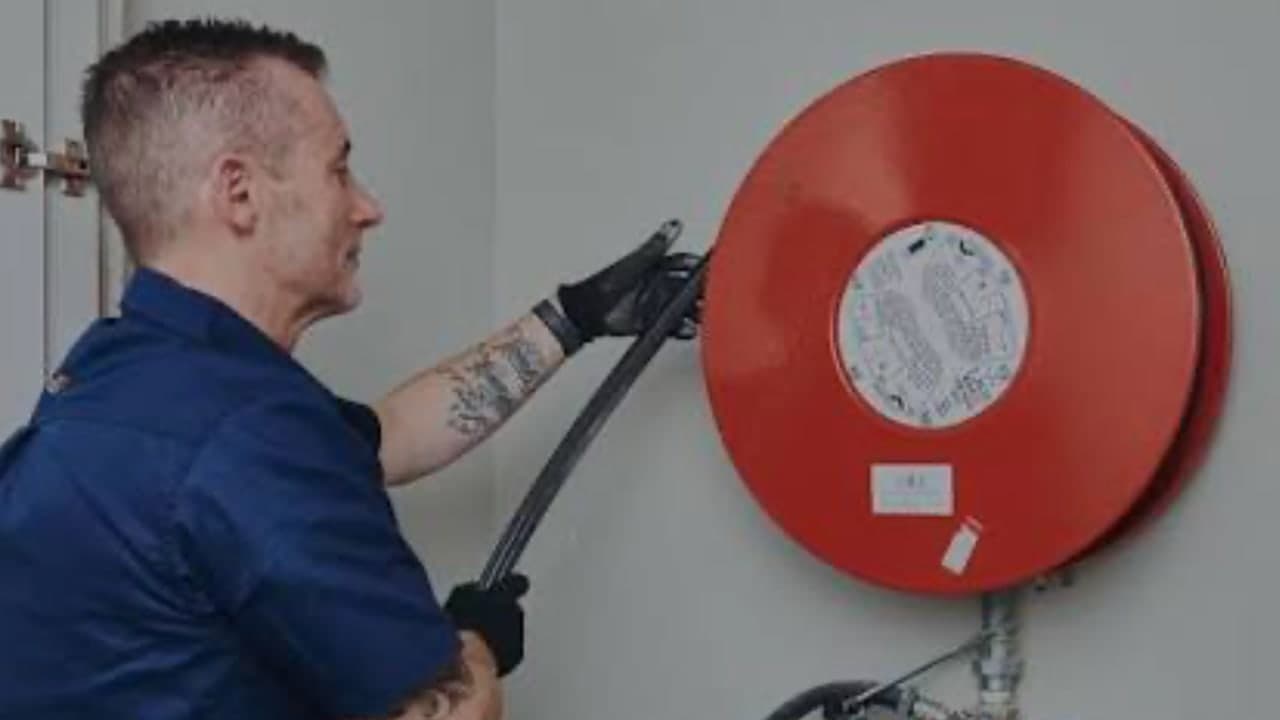
Hydrants and hose reels are the two systems a fire protection contractor touches most often and writes about least. Sprinklers get the engineering attention, panels get the callouts, and the hydrant system sits in a riser cupboard doing nothing measurable until the day a brigade pumps from it.
That is exactly why the servicing matters. A sprinkler head announces its own condition; a buried main losing pressure does not. The only thing standing between a building and a hydrant that cannot deliver water at the moment of attack is a routine service that was done properly and written down.
This guide covers both systems end to end: the standards they sit under, what happens at each interval, how the yearly flow and pressure test actually works, boosters, the defects that keep coming back, what to do when a system cannot make its numbers, and how to price the work so the contract holds its margin. Intervals below follow the structure of AS 1851-2012; always work from the current tables and the building schedule of maintenance rather than from memory.
Two systems, four standards
Hydrants and hose reels are separate systems with separate standards, and it is worth keeping them straight because clients routinely lump them together as fire equipment.
| System | Designed and installed to | Maintained to | Who it is for |
|---|---|---|---|
| Fire hydrant system | AS 2419.1 | AS 1851-2012, Section 4 | The attending fire brigade |
| Fire hose reel system | AS 2441 | AS 1851-2012, Section 5 | Occupants, for first attack on a small fire |
The distinction is not academic. A hydrant system exists so that a fire brigade can take water at a known flow and pressure from a known point. A hose reel exists so that an untrained occupant can put out a bin fire without waiting for anybody. They fail differently, they are tested differently, and the consequences of a defect are different in kind.
What a hydrant system is actually made of
Before the intervals make sense, it helps to name the parts, because the service covers all of them and the defects cluster in a few.
- The water supply: a town main connection, a stored water tank, or both. Tanks bring their own inspection requirements and their own failure modes.
- The pumpset, where one is fitted, covered separately by AS 1851 and worth reading about in its own right.
- The booster assembly: the brigade connection point at the building boundary, with its inlets, isolation valves, non-return valves and signage.
- Distribution pipework and isolation valves, including buried mains, risers and any sectional valves that can quietly isolate part of a building.
- Hydrant outlets (landing valves), their caps and chains, their outlet threads, and the space around them.
- Block plans and signage, so a brigade arriving at night can understand the system without you there to explain it.
- Attack hose and associated equipment where the building is required to hold it.
Note how much of that list is about somebody else using the system under pressure, in the dark, without briefing. A blocked booster, a missing block plan and a painted-over outlet are not cosmetic defects. They are the defects most likely to cost time at the one moment the system is needed.
The routine, interval by interval
AS 1851-2012 structures hydrant servicing across monthly, six-monthly, yearly and longer intervals, with each routine building on the one below it. The yearly service includes everything in the six-monthly, which includes everything in the monthly.
Monthly
- Confirm hydrant outlets, boosters and their surrounds are accessible, unobstructed and clearly identified.
- Check valves are in their correct operating position and, where fitted, that locking or supervision arrangements are intact.
- Check gauges read as expected and that any stored water supply is at its required level.
- Look for physical damage, corrosion, leaks and missing caps, chains or blanking caps.
- Record the result, including the absence of defects, against each item rather than as a single building-level tick.
Six-monthly
- Everything in the monthly routine, plus a closer physical inspection of valves, outlets and the booster assembly.
- Operate valves through their range where the routine calls for it, and confirm they seat and seal.
- Check signage, block plans and identification are present, legible and current for the building as it stands today.
- Inspect the condition of any attack hose and associated equipment held on site.
Yearly
- Everything above, plus the flow and pressure verification that gives the whole system its evidence base.
- Confirm the system still achieves the flow and residual pressure its design requires, measured at the point the design nominates.
- A full inspection of the booster assembly including non-return valves and inlet condition.
- A review of the system against the building as built: new walls, new tenancies, new landscaping and new car parking all change whether a hydrant is usable.
Longer intervals
The standard also carries multi-year activities that a monthly technician never sees: deeper internal inspection of valves, more comprehensive testing of the supply, and condition assessment of components with a finite life. These are the activities most often missed on takeover and most often left out of a tender price. When you inherit a building, work out when each long-interval activity was last done before you quote the contract, not after.
The yearly flow and pressure test, properly
This is the part of hydrant servicing that separates a real service from a walk-past, and it is the part most often done loosely. The purpose is not to prove water comes out. It is to prove the system still delivers its design flow at its design residual pressure at the point where that is hardest to achieve.
Test at the hydraulically most disadvantaged point
Every hydrant system has a worst case: the outlet that is highest, furthest from the supply, or on the longest run of pipework. That is the hydrant the design was sized around, and it is the hydrant the test has to be performed at. Testing a convenient ground-floor outlet near the booster proves nothing about the top of the building.
Test against the design figures, not against a number you remember
The flow and residual pressure a system must achieve come from its hydraulic design, and they vary with the building classification, the hazard and the fire brigade attack arrangement assumed at design. That is why AS 1851 leans so heavily on baseline data: the results of a test only mean something when there is a recorded design figure to compare them against. Where a building has no baseline data, record its absence as a non-conformance and tell the owner what it will take to re-establish it.
What to record
- Which hydrant was tested, and why it is the most disadvantaged point.
- Static pressure before flow, and residual pressure while flowing.
- Measured flow, the method used to measure it, and the equipment used.
- Whether the pumpset was running, and what it contributed.
- The design figures the result is being compared against, and their source.
- Weather, town main conditions or anything else that might explain an unusual result.
- The name of the technician and their accreditation, so the record answers who did this work and were they entitled to.
Where the water goes
A hydrant flow test moves a serious volume of water in a short time, and where it goes is a real planning problem. Flooded basements, scoured garden beds, water across a loading dock and complaints from neighbouring tenants are all common outcomes of a test nobody planned. Agree the discharge route with the building manager in advance, use a diffuser, and check whether the local water authority or council has anything to say about discharge to stormwater. In drought-affected areas, expect questions about the volume used, and be ready to explain why the test is a legal requirement rather than a waste.
Boosters: the part the brigade actually touches
If a brigade uses anything on the building, it is the booster. It is also the part most exposed to landscaping, parking, renovation and vandalism, which makes it the single most productive thing to inspect carefully.
- Access: can a pumping appliance get to it, and is there a clear working space in front of it? A booster behind a parked car, a skip bin, a new planter box or a locked gate is a defect, not an inconvenience.
- Identification: signage present, legible, and correct for the system. A booster that is not obviously a booster at three in the morning has failed at its only job.
- Block plan: present, legible, and matching the building as it stands. Buildings get extended and re-tenanted; block plans rarely keep up.
- Inlets and caps: clear of debris, threads undamaged, caps present, non-return valves holding.
- Security: where the enclosure is locked, that the brigade access arrangement is correct for the jurisdiction and actually works.
- Surrounds: drainage, corrosion, and whether the enclosure itself is still weathertight.
When you find a booster obstructed by something the tenant put there, photograph it in place before moving anything. That photograph is the difference between a defect the owner acts on and a disagreement about whether it was ever really blocked.
Fire hose reels: small system, constant defects
Hose reels are simple, cheap and everywhere, which is precisely why they are neglected. The service is quick, but there are a handful of checks that matter more than the rest.
The routine
- Location and access: the reel is where the schedule says it is, visible, signed, and not behind stock, furniture or a locked door.
- Condition: hose free of cuts, kinks, perishing and UV damage; nozzle present and operable; reel and guide mechanism intact.
- Operation: the reel turns, the hose runs out and rewinds, the stop valve operates, and the nozzle shuts off cleanly.
- Leakage: no weeping at the valve, the swivel or the nozzle. A constant drip is both a defect and a maintenance bill for the owner.
- Coverage: the hose actually reaches the area it is meant to protect, after whatever the tenant has built since the last visit.
The yearly flow test
The yearly service includes a flow check at the nozzle. AS 2441 sets the performance a hose reel must deliver, commonly expressed as a minimum flow of 0.33 litres per second at the nozzle, and the service confirms the installed reel still achieves it. A reel that dribbles is not a reel. Low flow usually points at a partially closed stop valve, a blocked nozzle, a crushed hose or a supply problem that affects more than the reel.
The long-interval items
Hose has a finite life. Rubber perishes, UV attacks it, and a hose that has been dragged across a loading dock for fifteen years is not the hose that was commissioned. The standard and the manufacturer both have something to say about replacement, and the practical answer on site is usually plain: if the hose shows perishing, cracking, delamination or repeated leaks, it is replaced, regardless of what the calendar says.
The defects that keep coming back
| Defect | Why it keeps happening | What it means on site |
|---|---|---|
| Booster obstructed | Parking, landscaping, bins and building works | Brigade access compromised; usually rectifiable same day by the owner |
| Block plan missing, illegible or out of date | Buildings change; nobody owns the drawing | Brigade cannot understand the system on arrival |
| Hydrant outlet painted over or seized | Repainting contractors and years without use | The outlet cannot be connected under pressure |
| Valve found in the wrong position | Works, tampering, or a previous isolation never restored | Part of the system may be dead without anyone knowing |
| Hose reel obstructed by stock or furniture | Tenant fitouts and warehouse operations | Recurs every visit unless the tenant is engaged directly |
| Hose reel leaking at the valve or swivel | Seals and constant standing pressure | Water damage and a slow, steady cost to the owner |
| System cannot achieve design flow or pressure | Town main changes, partially closed valves, corrosion, pump faults | Serious; needs investigation before any sign-off |
| No baseline data for the system | Documents lost across owners and contractors | Record as a non-conformance; results cannot be assessed without it |
Critical or not? Classifying what you find
AS 1851 asks you to classify what you find, and hydrant work produces a steady stream of judgement calls. The critical defect test turns on whether the system is rendered inoperable such that occupants are reasonably likely to be at significant risk in a fire. A single obstructed hose reel in a warehouse with six others is usually a non-critical defect; a closed sectional valve isolating the hydrant supply to four residential floors is not.
Where you land on the line, the reporting obligations follow: critical defects go to the responsible entity before you leave site or as soon as possible, confirmed in writing within 24 hours, while non-critical defects and non-conformances are notified within a week. The classification is a professional judgement you have to be able to defend, so write down the reasoning, not just the conclusion.
Isolations and impairments
Any hydrant or hose reel work that takes water off a system is an impairment, and it needs to be managed like one. Notify the monitoring provider and the building manager before you isolate, agree how long the isolation will last, and make sure the restoration is confirmed and recorded rather than assumed. Most of the hydrant systems found dead on a takeover survey were isolated deliberately, by somebody competent, for a good reason, and never restored.
When the system cannot make its numbers
Sooner or later a yearly test comes back short. The building has grown, the town main has changed, a valve is partly closed somewhere nobody can find, or the system was never right. This is the moment that defines the contractor.
- Repeat the test and confirm the result, with the method and equipment documented.
- Check the obvious causes first: valve positions throughout the system, strainers, pump operation and mode, and any recent works on site.
- Confirm what the system is actually required to achieve, from the design documentation rather than assumption.
- Report the shortfall in writing, classified, with the measured and required figures side by side.
- Recommend the next step honestly. A flow shortfall on a complex system is usually a hydraulic consultant question, not something a service contractor should design a fix for on the spot.
- Keep servicing the system. A system that fails its flow test is still maintained; the failure is recorded, not used as a reason to stop.
What you must not do is sign the system off because it nearly made it, or because the owner does not want to hear it. The test result is the record that will be read after an incident, and nobody has ever regretted writing down what they actually measured.
Pricing hydrant and hose reel work so it holds its margin
Hydrant and hose reel servicing is priced too low more often than any other system, because the monthly routine looks trivial and the annual work is invisible until it lands. The costs that get missed are consistent.
- The yearly flow test is frequently a two-person task, with equipment, planning and water management. Price it separately from the walk-around routine.
- Hose reel counts are almost always wrong in tender documents. Count them on a survey before you commit to a fixed fee.
- Access is the real cost in residential and mixed-use buildings: keys, notices to occupants, escorts and re-attendance for the units nobody answered.
- Travel and site time scale with buildings, not assets. Twelve small sites with four hose reels each is more work than one site with fifty.
- Long-interval activities need to be spread across the contract term and priced into it, not absorbed in the year they happen to fall.
- Water disposal, traffic management and after-hours access in operating buildings are legitimate line items.
- Defect rectification is separate work. A contract price that quietly includes minor repairs trains the client to expect it.
Frequently asked questions
How often do fire hydrants have to be tested in Australia?
Hydrant systems are maintained to AS 1851-2012 on a cycle that runs monthly, six-monthly and yearly, with additional activities at longer intervals. The flow and pressure verification sits in the yearly routine. The precise activities and tolerances come from the tables in the standard and the building schedule of maintenance.
Which hydrant do we flow test?
The hydraulically most disadvantaged one: highest, furthest, or on the longest pipe run, as the system design identifies. Testing a convenient outlet near the booster tells you nothing about the part of the building the design was sized around.
What flow does a fire hose reel need to achieve?
Hose reels are installed to AS 2441, which sets the performance the reel must deliver at the nozzle, commonly expressed as a minimum of 0.33 litres per second. The yearly service confirms the installed reel still achieves its required flow.
Is an obstructed hose reel a critical defect?
Usually not on its own, but it depends on the building. The test is whether the system is inoperable in a way that puts occupants at significant risk. One blocked reel among several in a large warehouse is normally a non-critical defect; the only hose reel serving a high-risk area behind a locked roller door is a different conversation.
Who is responsible for clearing access to a booster?
The building owner or responsible entity. Your job is to identify and report it, with a photograph of the obstruction in place. Persistent obstruction by a tenant is worth escalating in writing, because it is one of the few defects that can be fixed the same day at no cost.
Do we need to notify anyone before a flow test?
Yes. Tell the building manager and the monitoring provider, agree the water discharge route, and confirm whether any isolation is required. Restoring and confirming the system afterwards is part of the job, not an afterthought.
The building has no hydraulic design data. Can we still service it?
Yes. Carry out the routine service, record the absence of baseline data as a non-conformance, and record your measured results as the starting data set. Then quote the owner to have the design figures re-established, because without them nobody can say whether a future result is a pass or a failure.
Sources and further reading
- AS 1851-2012 Routine service of fire protection systems and equipment, Standards Australia
- AS 2419.1 Fire hydrant installations, Standards Australia
- AS 2441 Installation of fire hose reels, Standards Australia
- Good practice guide for the inspection, testing, maintenance and repair of fire protection systems in NSW buildings, Building Commission NSW (January 2026)
- FSG-05 Maintenance of fire protection systems and equipment, ACT Fire & Rescue (August 2023)