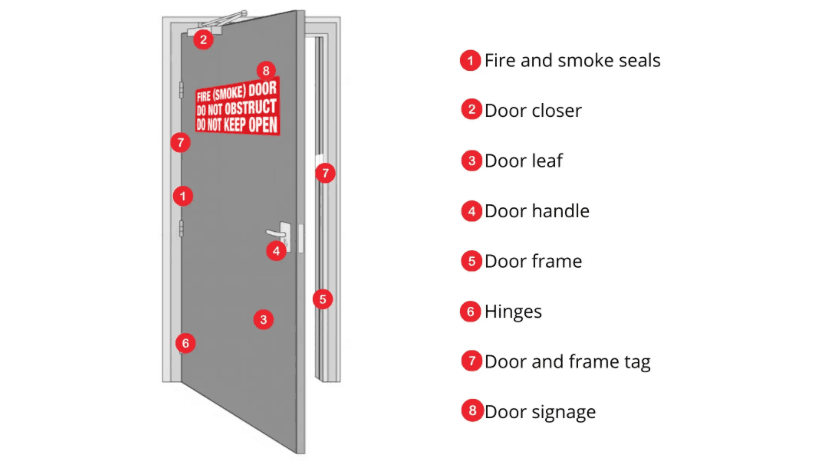
In most buildings the fire door is the most-used piece of fire protection there is. It’s opened hundreds of times a day, propped open for deliveries, kicked, painted, drilled for a new lock and fitted with whatever closer was in the van. That’s why fire and smoke doors generate more defects than almost any other measure, and why a door inspection is never just a glance at the closer.
A fire door only works if it closes, latches and seals in a fire. One that doesn’t is just a door, and the compartment behind it is no longer a compartment. This guide covers what makes a compliant doorset, how often doors are inspected in each state, what to check on every door, the clearances, tags, the defects that keep failing, repairs, who can do the work, and the law on propped doors.
What makes a fire door a fire door
Under the National Construction Code, a required fire door must comply with AS 1905.1, Components for the protection of openings in fire-resistant walls, Part 1: Fire-resistant doorsets. The current edition is AS 1905.1:2015.
The key word is doorset. A fire door isn’t a leaf; it’s the leaf, frame, hardware and seals, tested and approved together. Queensland Fire Department describes a fire door as the leaf, frame and hardware with matching fire door tags on the door and the frame. Change one part without regard to the rest and you may no longer have a fire door.
- Self-closing and self-latching: AS 1905.1 requires the doorset to be self-closing, and every doorset other than a sliding one to be self-latching.
- Compatible hardware: Queensland Fire Department notes that the standard requires all fittings on a fire doorset to comply with that doorset’s fire rating, and that hardware must be tested and approved by a registered testing authority.
- A properly installed frame: Building Commission NSW’s defects library notes AS 1905.1 requires metal frames to be grouted or backfilled with material that has a fusion temperature of at least 1000°C, not left hollow.
- Tags on the leaf and the frame, identifying the doorset and its rating.
Smoke doors are different
Smoke doors stop smoke rather than fire, and the NCC’s deemed-to-satisfy construction for them (Specification 12) is its own set of rules. In summary, smoke door leaves must be normally closed, or close automatically when smoke detectors (located on each side of the doorway, no more than 1.5 m from it) operate. On power failure they must fail safe in the closed position, and they must return fully closed after each manual opening. The leaves need smoke seals and must be solid-core at least 35 mm thick, or otherwise resist smoke at 200°C for 30 minutes.
Other doors on the schedule
Fire and smoke doors aren’t the only doors in a building’s fire safety measures. Victoria’s Building Regulations 2018 list fire doors (including sliding fire doors, their warning systems and their closing and latching mechanisms), solid core doors and smoke doors as essential safety measures, along with other doors in required exits and the signs warning people not to impair door operation. ACT Fire & Rescue’s guideline sets an annual inspection for solid core doors, checking for damage and deterioration and the operation of closers, handles and electric strikes.
How often doors are inspected
There isn’t one national answer. AS 1851-2012 covers fire and smoke doors in Section 12 (passive fire and smoke systems), and Building Commission NSW’s frequency matrix shows passive fire and smoke routine service at three-monthly (± 10 working days), six-monthly (± 1 month), yearly (± 2 months) and 25-yearly (± 6 months) intervals. Which door activities fall at which interval is set out in the Section 12 tables. Work from a current copy of the standard, not from memory.
| Jurisdiction | What sets the frequency | What to know |
|---|---|---|
| NSW | AS 1851-2012, mandatory for Class 1b and Class 2 to 9 buildings from 13 February 2026 | Passive fire and smoke intervals of three-monthly, six-monthly, yearly and 25-yearly, with tolerances |
| Victoria | The building’s occupancy permit or maintenance determination | Fire doors, solid core doors and smoke doors are essential safety measures; AS 1851-2012 can be substituted where AS 1851-2005 was specified |
| Queensland | Queensland Development Code MP 6.1, Schedule 1 | Queensland Fire Department says fire doors must be inspected six-monthly in Class 5, 6, 9a and 9c buildings, and yearly in other classes |
| ACT | AS 1851 under the Emergencies Act | FSG-05 maps fire and smoke doors to AS 1851-2012 Section 12; solid core doors inspected annually; doors and doorways three-monthly |
Wherever you are, the building’s own documents decide the detail: the fire safety schedule, occupancy permit or maintenance determination. And an inspection done outside its tolerance is an out of tolerance activity: recorded as a non-conformance and carried out as soon as practical.
What to check on every door
FPA Australia’s fact sheet for its Inspect and Test accreditation lists the activities expected of a technician on fire and smoke doors. In plain terms, every inspection covers:
- Modifications that differ from the approved design.
- Signage.
- Gaps between the leaf and the frame, and clearances and overlaps when closed.
- Damage to the door leaf and frame.
- Door and latch function.
- Function under simulated alarm and power-fail conditions, for doors with automatic operation.
- A full operational test.
- The door leaf and frame tags.
- Fittings: hinges, handles, closers, tracks.
- Fusible links, where fitted.
- Installation in line with the manufacturer’s details.
A practical order of work
- Look at the door closed: gaps, damage, tags, signage, and anything added since last time.
- Open it fully and let it go. It should close from any angle and latch without anyone helping it.
- Check the hardware: hinges tight, closer adjusted, latch engaging, handles and furniture intact.
- Check the seals: present, undamaged, and not painted over or removed.
- Test any hold-open or automatic operation: the door should release and close on a simulated alarm, and on loss of power where it’s designed to.
- Look for holes and modifications: new locks, cable penetrations, peepholes, kick plates, pet doors.
- Record the result as a pass or fail against the door, tag it, and log each defect with a photo and a location.
Clearances: the numbers that decide pass or fail
Gaps are where fire and smoke get through, and they grow as doors drop, hinges wear and frames move. AS 1905.1:2015 sets the clearances for installed doorsets; Building Commission NSW’s defects library reproduces them:
| Where | Requirement |
|---|---|
| Bottom of leaf to floor, including floor covering | Not less than 3 mm and not more than 10 mm |
| Bottom of leaf to top of a non-combustible threshold | Not more than 25 mm |
| Side-hung leaf to head and stiles, when closed | Mean clearance not more than 3 mm |
| Leaf face to doorstop | Mean not more than 3 mm, and not more than 5 mm at any point |
| Double-acting and sliding doorsets | As tested or assessed |
These are installation requirements under AS 1905.1, and the practical reference point when you measure a door in service. Two traps are worth watching for: new carpet or tiles that change the floor clearance, and doors trimmed to clear new flooring, which can take them outside their tested configuration.
Tags and labels
- Compliance tags on the leaf and the frame identify the doorset. Queensland Fire Department says the tag information must include the component standard, fire-resistance level, manufacturer, applicant, certifier, tag number and year of manufacture.
- In Queensland, buildings approved after 1 April 1976 require tags on their fire doors, as do fire doors replaced after that date.
- Separately, AS 1851-2012 uses tags and labels (clause 1.16.4) to record routine service on passive fire and smoke assets, supported by a hard-copy summary record for the owner listing the equipment, the work done and anything missing or defective.
The defects that keep failing
Propped and wedged doors
The classic. A wedge under a fire door turns a compartment into an open plan. In Queensland, chocking open a door on the perimeter of a fire-isolated compartment is given in the Building Fire Safety Regulation as an example of a prohibited act, and Queensland Fire Department describes wedging as illegal. In NSW it’s an offence to interfere with or obstruct the operation of a fire door providing access to a fire exit.
Doors that don’t close or latch
A closer out of adjustment, a latch that doesn’t engage, a leaf that binds on the frame or floor. Building Commission NSW lists a required fire door that doesn’t self-close and latch as a common building defect.
Excessive gaps
Worn hinges, dropped leaves and moved frames. Measure and record, so you can see the trend as well as the fail.
Damaged or painted seals
Intumescent and smoke seals are easily damaged and routinely painted over during redecoration. A seal that can’t expand or seal isn’t doing its job.
Non-compliant hardware and modifications
New locks, handles, closers or security hardware that aren’t part of the tested doorset; holes drilled for cabling or access control; peepholes, kick plates and pet doors. Fire and Rescue NSW advises against fitting security or screen doors to unit entry fire doors, because they increase the likelihood of the fire door being propped open and fitting them can compromise the frame. It also says fire doors shouldn’t be fitted with supplementary fire-activated retaining devices that render the door inoperable once activated by fire.
Hold-open devices that don’t release
Magnetic hold-opens and automatic closers are legitimate, but only if they release when they should. Test release on a simulated alarm, and on power failure where designed to.
Missing signage
In NSW, owners must display a fire safety notice next to each doorway giving access to a fire-isolated stair, passageway or ramp. Victoria lists signs alerting people not to impair the operation of doors among its essential safety measures.
Classifying door defects
Classification depends on what the door does. A fire door that won’t close or latch into a fire-isolated stair may leave that exit exposed to smoke and fire, making it a strong candidate for a critical defect. A worn closer on a door that still closes and latches is typically non-critical. Missing signage or illegible service tags are typically non-conformances. Classify on the evidence and record why.
Repair, adjust or replace?
- Adjust: closers, latches, hinges and seals are routine maintenance items, as long as replacements are compatible with the tested doorset.
- Repair: repairs must keep the doorset in its approved configuration. Building Commission NSW notes that repairs restoring a measure to its original design generally don’t need approval, but alterations that affect compliance can.
- Replace: when the leaf or frame is damaged beyond repair, or has been modified out of its tested configuration, replace it with a compliant, tagged doorset.
Queensland Fire Department’s fire door information sheet also flags a recall of Korab doors with a pyrokor core supplied between 1 January 1993 and 3 September 1998, and warns that doors made before 1990 may contain asbestos. Check before anyone drills, cuts or planes an old door.
Who can inspect and repair fire doors
- NSW: fire doors aren’t listed among the licensed specialist trades for fire safety work, and Building Commission NSW notes FPAS accreditation isn’t required for AS 1851-2012 work. But its guide also notes that passive fire protection isn’t fully covered by existing units of competency, so competency may need to be shown through additional experience, training or supervision.
- Queensland: QBCC licenses fire protection work. The passive stream includes an inspect-and-test licence (covering fire doors, shutters, dampers, collars and more) and an install-and-maintain licence for fire doors and fire shutters. Carpenters and joiners can install and repair fire doors but can’t certify, inspect or test them, and locksmith work on locks, closers, seals and hinges doesn’t need a fire protection licence.
- Industry accreditation: FPA Australia’s Inspect and Test accreditation includes a fire and smoke doors category.
The law on propped and obstructed doors
| State | Provision | What it says |
|---|---|---|
| NSW | Environmental Planning and Assessment (Development Certification and Fire Safety) Regulation 2021, s 109 | A person must not interfere with or obstruct the operation of a fire door providing access to a fire exit; the owner must keep fire exit areas clear. Maximum 150 penalty units for a corporation and 75 for an individual, with a $1,500 penalty notice. |
| NSW | Same Regulation, s 108 | A fire safety notice must be displayed next to each doorway giving access to a fire-isolated stair, passageway or ramp. |
| Victoria | Building Regulations 2018, regs 226 to 228 | Owners must keep essential safety measures fulfilling their purpose and not remove them; occupiers must keep exits and paths of travel accessible, functional and clear. 20 penalty units each. |
| Queensland | Building Fire Safety Regulation 2008, s 13 | Chocking open a door on the perimeter of a fire-isolated compartment is a prohibited act; owners and occupiers must ensure nobody does it. Maximum 30 penalty units. |
Doors that need to stand open have a legitimate option: an automatic hold-open device that releases the door in a fire. Queensland Fire Department says fire and smoke doors can only be held open by a device linked to the fire alarm and approved by a building certifier. If a client wants a door open, that’s the conversation to have, and often a quote.
Records
- Each door’s result recorded as a pass or fail against the relevant AS 1851 section and interval, with defects and corrective action.
- Service tags on the door, and a hard-copy summary record for the owner.
- A hard copy of the logbook left on site at the end of every routine service. Building Commission NSW notes the standard doesn’t yet allow an electronic register to replace the physical logbook.
- Records kept for at least seven years in NSW.
Building Commission NSW also notes there’s no requirement for a passive fire register under AS 1851-2012. In practice, a register of every door (location, rating, tag details and history) is what makes inspections fast and defects traceable.
Frequently asked questions
How often do fire doors need to be inspected?
It depends on the state and the building. Under AS 1851-2012, passive fire and smoke systems have three-monthly, six-monthly, yearly and 25-yearly activities. In Queensland, fire doors are inspected six-monthly in Class 5, 6, 9a and 9c buildings and yearly in other classes. In Victoria, the occupancy permit or maintenance determination sets the frequency.
Can a fire door be held open?
Not with a wedge. It can be held open by an approved automatic device that releases it in a fire (in Queensland, one linked to the fire alarm and approved by a building certifier).
Can we fit a new lock or closer to a fire door?
Only hardware compatible with the doorset’s fire rating and tested configuration. Non-compliant hardware is one of the most common door defects.
Is a missing compliance tag a defect?
It means the door can’t be shown to be a compliant fire door. Record and report it, and involve the manufacturer or an appropriately qualified person to resolve it.
Do we need a passive fire register?
AS 1851-2012 doesn’t require one, according to Building Commission NSW, but a door-by-door register makes inspections and defect tracking far easier.
Sources and further reading
- Good practice guide for the inspection, testing, maintenance and repair of fire protection systems in NSW buildings, Building Commission NSW (January 2026)
- Responsibilities of building owners under AS 1851-2012, Building Commission NSW
- Building Defects Library, Building Commission NSW (June 2025)
- NCC 2022 Volume One, Specification 12: Fire doors, smoke doors, fire windows and shutters, ABCB
- Fire doors (fire-resistant doorsets) information sheet, Queensland Fire Department
- Fire Safety Management Tool advisory notes, Queensland Fire Department
- Building Fire Safety Regulation 2008 (Qld)
- Building Regulations 2018 (Vic), Victorian Legislation
- Environmental Planning and Assessment (Development Certification and Fire Safety) Regulation 2021 (NSW)
- FSG-05 Maintenance of fire protection systems and equipment, ACT Fire & Rescue (August 2023)
- Position statements, Fire and Rescue NSW
- FPAS Inspect and Test accreditation fact sheet, FPA Australia