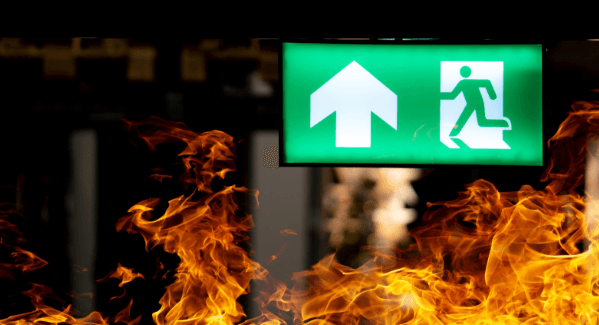
When the power fails in a fire, emergency lighting and exit signs are what get people out of a dark, smoke-filled building. They’re also among the most neglected measures in the schedule: thousands of small fittings, each with a battery quietly ageing, in buildings where nobody notices a problem until the lights go out.
Emergency lighting sits slightly apart from the rest of fire protection. It isn’t covered by AS 1851; it has its own standard, AS/NZS 2293.2, and in most states the work on it is electrical work. This guide explains the AS/NZS 2293 family and its current editions, what the NCC requires, the routine service intervals, discharge testing, batteries and LED light source life, records, licensing, and how each state treats it.
The three parts of AS/NZS 2293
| Part | What it covers | Current edition |
|---|---|---|
| AS/NZS 2293.1 | System design, installation and operation, including central battery and single-point (self-contained) systems | AS/NZS 2293.1:2026, published June 2026 (superseding the 2018 edition and its 2021 amendment) |
| AS/NZS 2293.2 | Routine service and maintenance | AS/NZS 2293.2:2019, which replaced the 1995 edition; a revised AS 2293.2 has been out for public comment |
| AS/NZS 2293.3 | The emergency luminaires and exit signs themselves: design, construction, performance and testing | AS/NZS 2293.3:2026, published June 2026 |
Which edition applies to a particular building depends on its approvals and your state’s rules, not simply on what’s newest, as the state-by-state section below shows. Always check the fire safety schedule, occupancy permit or maintenance determination.
What the NCC requires
- Where emergency lighting is required: clause E4D2 of NCC 2022, including fire-isolated stairways, passageways and ramps, and larger storeys of Class 5 to 9 buildings.
- How it must work: every required emergency lighting system must comply with AS/NZS 2293.1 (E4D4).
- Exit signs and direction signs: where they’re required (E4D5 and E4D6), and that they must comply with AS/NZS 2293.1, or Specification 25 for photoluminescent signs, and be clearly visible at all times when the building is occupied (E4D8).
- Photoluminescent exit signs: Specification 25 requires at least 100 lux on the sign face from a dedicated light source of at least 4000 K, and a luminance of at least 30 mcd/m² for not less than 90 minutes after power fails.
NCC 2025 was released on 1 May 2026. Victoria and Tasmania adopted it from that date, the ACT and WA with a 12-month transition, and NSW and Queensland from 1 May 2027. Building approvals, and therefore the design requirements you inherit, will reference whichever edition applied at the time.
What changed with AS/NZS 2293.2:2019
The 2019 edition brought emergency lighting maintenance much closer to the way AS 1851 works. According to its official summary, it:
- aligned the layout with AS 1851, using tables of routine service activities;
- introduced baseline data;
- covered routine service including preventative maintenance, and procedures for intervals longer than 12 months;
- introduced critical defects, non-critical defects and non-conformances, with reporting requirements; and
- added light source life assessment for LED luminaires and exit signs.
If your emergency lighting reports still read like the 1995 checklist (a date, a tick and “all OK”), they may not reflect what the 2019 edition asks for.
The routine service intervals
Appendix A of AS/NZS 2293.2:2019 sets out the routine service requirements at three levels:
| Interval | What it’s about |
|---|---|
| Six-monthly | The regular inspection and test cycle for fittings and signs |
| Yearly | The annual requirements, including the yearly condition report |
| 10-yearly and end of light source life | Longer-term replacement and assessment, including LED light source life |
The standard also sets frequencies and tolerances for these intervals (clause 2.5), records and reporting requirements (clauses 2.6 and 2.7), and critical defect and yearly condition report requirements (clause 2.8 and Appendix D). Work from a current copy for the detail. Some regulators add their own checks on top: South Australia’s Ministerial Building Standard MBS 002, for example, asks for power availability to be checked monthly in addition to the Appendix A procedures.
The discharge test
The heart of emergency lighting maintenance is the discharge test: take the fittings off mains power and prove each one stays lit for the required time on its own battery. A fitting can look perfect on charge and fail within minutes on battery. The test is the only way to know.
How long “the required time” is depends on the edition and the design. The City of Cockburn’s guideline, which is based on the 1995 edition, summarises its requirement as the mains being uninterrupted for 16 hours beforehand, and fittings remaining lit for no less than two hours when batteries are new and no less than 90 minutes on all later tests. That edition still matters (Queensland’s MP 6.1 names AS/NZS 2293.2:1995), but check the 2019 edition and the building’s design documents for the duration that applies to your building.
Running it well
- Plan it out of hours, and tell the building manager. The building will have reduced emergency lighting capacity until the batteries recharge.
- Make sure the batteries have been fully charged beforehand.
- Simulate mains failure for the circuits under test, and record the start time.
- Walk the building during the test and check every fitting and sign, not just the ones near the switchboard.
- Record each fitting that fails, with its identifier and location, and the time it went out if it failed early.
- Restore mains, and confirm every fitting has returned to normal and is charging.
- Report failures, classified, and quote the repairs.
Batteries, chargers and LED light source life
- Batteries age. Standards Australia puts it simply: an old light source or an old battery is likely to produce a lower light output than a new one tested in a laboratory. Capacity loss is the most common reason fittings fail their discharge test.
- AS/NZS 2293.2:2019 includes an appendix on battery and charger maintenance, and procedures for replacing batteries and fittings in both self-contained and central battery systems.
- The City of Cockburn’s 1995-based guidance says to replace the whole battery pack with the same type and amp-hour capacity, and to discharge test the fitting afterwards.
- LED fittings don’t fail like old lamps. They fade. The 2019 edition added light source life assessment and end-of-life procedures for maintained LED fittings, and the 2026 edition of AS/NZS 2293.3 adds light source life marking for maintained luminaires.
System types
Maintained and non-maintained fittings
A non-maintained fitting’s emergency lamps light only when the normal lighting fails. A maintained fitting’s emergency lamps are on all the time, which matters for light source life, because they’re always burning.
Single-point and central battery systems
Single-point (self-contained) fittings each carry their own battery and charger; central battery systems feed many fittings from one battery bank. AS/NZS 2293.1 covers both, and AS/NZS 2293.2 has separate procedures for each. A central battery failure takes out every fitting on the system at once, so battery and charger condition there is especially critical.
Monitored and automatic testing systems
Many newer installations test themselves and report faults to a computer or panel. AS/NZS 2293.1:2026 covers automatically operated testing facilities, and AS/NZS 2293.2:2019 includes guidance on computer system maintenance (Appendix F). Automatic testing changes how the work is done, but it doesn’t remove the need for records, for checking the monitoring system itself, or for a competent person to review the results.
Exit signs
- Exit signs must be clearly visible at all times when the building is occupied, which means obstructions, dirty or broken covers, and failed lamps are all findings.
- Direction signs must point the right way. Wrong or missing arrows after fit-outs are a classic defect.
- Photoluminescent signs work differently: they need their dedicated charging light to be on and meet Specification 25. They were left out of AS/NZS 2293.2:2019, which notes the standard could be used as a model for maintaining them.
- AS/NZS 2293.1:2026 adds guidance on exit sign visibility where lighting control systems are used, which is relevant in buildings with sensor-controlled lighting.
Common defects
| Finding | Typical classification |
|---|---|
| A central battery system that fails its discharge test | Critical: every fitting on the system is affected |
| Emergency lighting missing or failed in a fire-isolated stair or exit path | Often critical, as occupants may not be able to find their way out |
| Individual fittings failing the discharge test | Usually non-critical, depending on how many and where |
| Exit sign obstructed, dark, or with the wrong direction arrow | Depends on location and extent |
| Dirty, broken or missing covers and diffusers | Usually non-critical |
| Fittings without identifiers, or missing records | Non-conformance |
As with AS 1851, classification depends on the building and the evidence. Queensland Fire Department’s guidance to occupiers even includes basic checks (exit sign covers clean, in place and unbroken; lamps clean, in place and undamaged), which shows how visible these defects are to anyone who looks.
How each state treats emergency lighting
| State | Maintenance requirement | Notes |
|---|---|---|
| NSW | Not covered by AS 1851-2012; maintained to the standard in the fire safety schedule or to its original design | Building Commission NSW lists emergency and exit lighting as licensed electrical work |
| Victoria | As specified in the occupancy permit or maintenance determination | Emergency lighting and exit signs (including direction signs) are essential safety measures |
| Queensland | QDC MP 6.1 names AS/NZS 2293.2:1995 for emergency lighting | A logbook (which can be electronic) must record six-monthly and annual inspections |
| ACT | AS/NZS 2293.2 “as in force from time to time” is a proper maintenance standard | ACT Fire & Rescue’s guideline says to use the latest edition |
| South Australia | MBS 002 points to Appendix A of AS/NZS 2293.2 | Adds a monthly check that power is available |
Who can do the work
- NSW: Building Commission NSW lists electrical work, including emergency and exit lighting, as specialist work that must be done under an appropriate licence.
- Queensland: Queensland Fire Department says a licensed electrician or appropriately qualified person must carry out maintenance inspections. QBCC moved emergency lighting licensing into its electrical stream on 1 May 2021, including an inspect-and-test class for emergency lighting, which QBCC defines as including the associated signage.
- Everywhere: anything that involves work on the electrical installation is electrical work under your state’s electrical licensing laws.
Records
- A logbook recording each routine service, the results and the defects found. Queensland Fire Department notes it can be electronic.
- A unique identifier and location for every fitting, so a failure can be found and fixed. The 2026 edition of AS/NZS 2293.1 clarifies labelling, including unique identifiers.
- Discharge test results by fitting, battery replacement dates and light source life information for maintained LED fittings.
- A yearly condition report, as AS/NZS 2293.2:2019 requires.
Records are where many buildings fall down. A Victorian government survey of essential safety measures in Class 2 buildings found that none of the buildings surveyed had a complete set of maintenance documents, and 18% of owners couldn’t produce their latest annual essential safety measures report.
Planning replacements before they fail
Emergency lighting is a system of consumables. Batteries lose capacity, LED light sources fade, and central battery banks reach the end of their life all at once. The discharge test tells you what failed this time; your records tell you what’s about to.
- Record the installation or replacement date of every battery, and track discharge test results by fitting. A fitting that only just passed is next year’s failure.
- Track light source life for maintained LED fittings, which are always on.
- Plan central battery replacement as a project, with the building’s emergency lighting covered while the work is done.
- Group replacements by floor or area, so the owner gets one planned job rather than a dribble of call-outs.
- Share a forward replacement plan with the owner, with years and indicative costs, the same way you would for long-interval AS 1851 work.
Taking over an emergency lighting system
- Find out which standard and edition the building’s documents require, as it may not be the current one.
- Get the previous logbook and the last discharge test results, fitting by fitting if they exist.
- Check that every fitting and sign has a unique identifier and a recorded location; if not, label and record them before the first test.
- Confirm whether there’s a central battery system or a monitoring and automatic testing system, and get access to it.
- Walk every exit path and stair and compare the fittings with the drawings, because fit-outs often add, move or remove fittings without updating anything.
- Price it as its own line, separate from AS 1851 work. It’s a different standard, and often a different licence.
- Count the fittings and signs, and note whether they’re single-point or central battery, maintained or non-maintained.
- Allow for after-hours discharge testing and the walk-around it takes to check every fitting.
- Quote battery replacements and end-of-life LED replacements as scheduled, forecastable work rather than surprises.
- Check that the system’s monitoring or automatic testing (if any) is itself included in the scope.
Frequently asked questions
Is emergency lighting part of AS 1851?
No. Building Commission NSW gives emergency exit lighting as an example of a measure not covered by AS 1851-2012. It’s maintained to AS/NZS 2293.2, or the standard in the building’s fire safety documents.
How often is emergency lighting tested?
AS/NZS 2293.2:2019 sets six-monthly, yearly, and 10-yearly or end of light source life requirements. Some regulators add checks: South Australia adds a monthly power availability check.
How long should emergency lights stay on during a discharge test?
It depends on the edition and the design. Summaries of the 1995 edition give at least two hours with new batteries and at least 90 minutes on later tests; check the 2019 edition and the building’s design documents for what applies.
Do automatic self-testing systems remove the need for manual testing?
They change how testing is done, but the monitoring system still needs maintaining and the results still need reviewing and recording. AS/NZS 2293.2:2019 includes guidance on computer system maintenance.
Do I need an electrical licence?
In NSW emergency and exit lighting work is licensed electrical work, and in Queensland it’s done by a licensed electrician or an appropriately licensed person. Check your state’s electrical licensing rules.
Are photoluminescent exit signs allowed?
Yes, where they meet NCC Specification 25, including a dedicated light source of at least 4000 K providing at least 100 lux on the sign face. They’re outside the scope of AS/NZS 2293.2:2019, which notes the standard could be used as a model for maintaining them.
Which edition of AS/NZS 2293.2 should we service to?
The one the building’s approvals and your state require. The current edition is 2019, but Queensland’s MP 6.1 still names the 1995 edition, and NSW requires maintenance to the standard in the fire safety schedule or the original design.
- AS/NZS 2293.2:2019 Emergency lighting and exit signs for buildings: Routine service and maintenance, Standards New Zealand
- AS/NZS 2293.2:2019 summary of changes, Building Performance CodeHub (NZ)
- AS/NZS 2293.1:2026 System design, installation and operation, Standards New Zealand
- NCC standards spotlight: emergency lighting and exit signs, Standards Australia
- NCC 2022 Volume One, Part E4: Visibility in an emergency, exit signs and warning systems, ABCB
- NCC 2022 Specification 25: Photoluminescent exit signs, ABCB
- NCC 2025 state and territory adoption, ABCB
- Responsibilities of building owners under AS 1851-2012, Building Commission NSW
- Fire Safety Management Tool advisory notes, Queensland Fire Department
- Changes to the emergency lighting licence, Queensland Building and Construction Commission
- Essential safety measures survey, Victorian Government
- FSG-05 Maintenance of fire protection systems and equipment, ACT Fire & Rescue (August 2023)