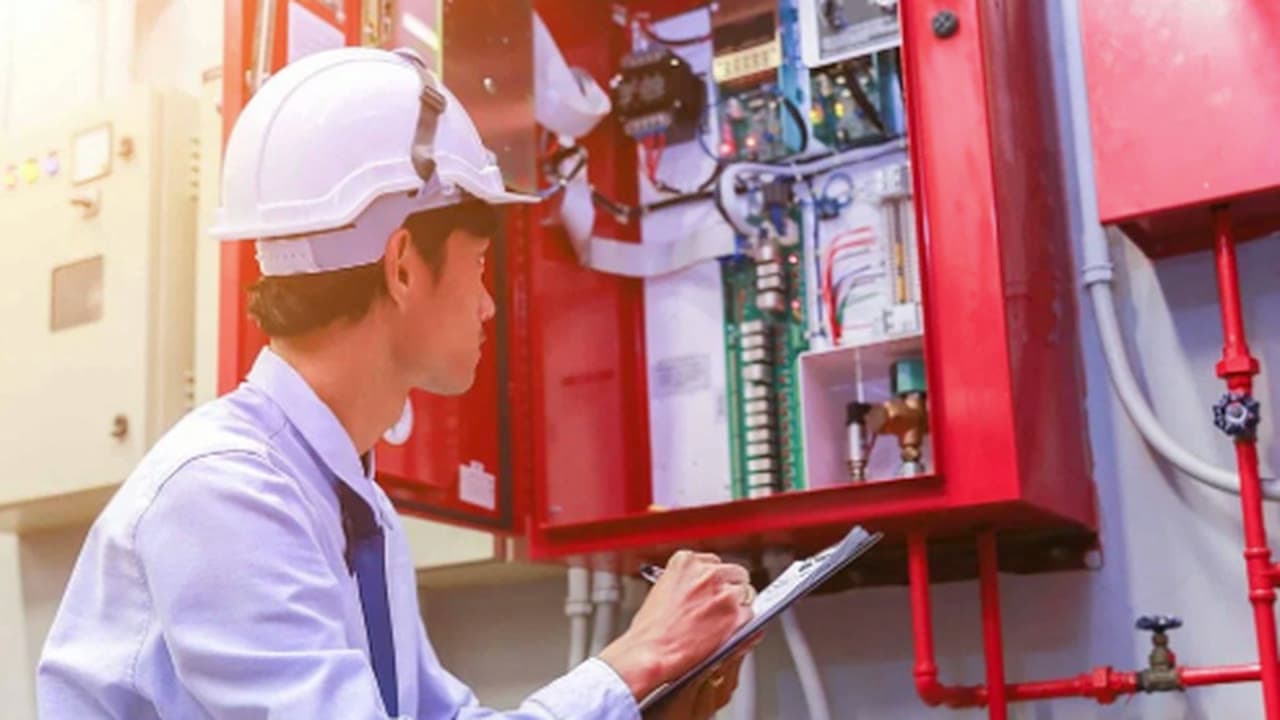
Fire protection is one of the few trades where most of the work is not building something new. It is keeping existing systems ready for the one day they are needed: the sprinkler that has to open, the alarm that has to sound, the extinguisher that has to discharge, the fire door that has to close. That work is steady, it is required by law in every state, and the industry has been short of people who can do it properly for years.
This guide is written for two readers. If you are thinking about becoming a fire protection technician, it explains what the job involves, which qualifications matter, how licensing works in your state and what your first two years will actually look like. If you run a fire business and are hiring, it covers the same ground from the other side, with a section on how to onboard and supervise new technicians so they become productive faster without cutting corners.
What a fire protection technician actually does
Most fire protection technicians in Australia work in maintenance: routine inspection, testing and preventive maintenance of systems in existing buildings. The benchmark for that work is AS 1851-2012, Routine service of fire protection systems and equipment, which sets out what is checked, how it is tested and how often, from monthly checks through to five, ten, twenty-five and thirty year tasks. Building owners are required by state law to keep their essential fire safety measures maintained, and contractors employ technicians to do it.
A typical service visit means arriving at a site, reviewing the asset list for the building, inspecting and testing each item against the relevant AS 1851 schedule, recording a result for every asset, identifying and describing defects, and leaving the client with a service report. Some defects are rectified on the spot; others become a quote for repair work.
Installers and service technicians
The industry broadly splits into two kinds of work, and many businesses do both:
- Installation: fitting new systems in new buildings or fit-outs, from running sprinkler pipework and hydrant mains to cabling detection systems and installing passive fire products. This is project work, often on construction sites, and the trade roles (such as fire sprinkler fitter) typically come through a four year apprenticeship.
- Service and maintenance: inspecting, testing and maintaining systems that are already installed, to AS 1851. This is recurring work across many sites, often several in a day, with a strong emphasis on accurate records.
The main disciplines
Fire protection is not one skill set. Technicians usually start in one or two areas and add more over time:
| Discipline | What it covers | Typical starting point? |
|---|---|---|
| Portable equipment | Extinguishers, fire blankets, hose reels; inspection, testing and workshop maintenance | Yes, the most common entry point |
| Emergency lighting and exit signs | Discharge testing and inspection of emergency luminaires and exit signs | Often, alongside portables |
| Water-based systems | Sprinklers, hydrants, hose reels, pumpsets, valves and boosters | Often, with flow and pump testing learnt under supervision |
| Detection and alarms | Fire indicator panels, detectors, alarm signalling, occupant warning and EWIS | Usually after some experience; some work needs an electrical licence |
| Passive fire | Fire and smoke doors, penetration seals, fire collars, dampers and walls | Increasingly, as regulators focus on passive systems |
| Special hazards | Gaseous suppression, kitchen and vehicle systems, foam | Usually later, as a specialisation |
The qualifications: what exists and what each is for
Fire protection qualifications sit in two national training packages: the CPP Property Services Training Package (for inspection and testing roles) and the CPC Construction, Plumbing and Services Training Package (for the trade sprinkler fitting role and fire systems design). They are delivered by registered training organisations (RTOs), and much of the training for working technicians is workplace based, with recognition of prior learning available for experience you already have.
The codes below were checked against training.gov.au at the time of writing. Training packages are updated, and a code can be superseded by a new version, so confirm the current code with your RTO before you enrol.
| Qualification | Training package | Who it is for |
|---|---|---|
| CPP20521 Certificate II in Fire Protection Inspection and Testing | CPP Property Services | New technicians doing non-trade installation and regular servicing of fire equipment and systems |
| CPP30821 Certificate III in Fire Protection Inspection and Testing | CPP Property Services | Technicians doing commissioning and complex servicing, or supervising fire protection service work |
| CPC32820 Certificate III in Fire Protection | CPC Construction, Plumbing and Services | The trade role of fire sprinkler fitter, usually through an apprenticeship |
| CPC50520 Diploma of Fire Systems Design | CPC Construction, Plumbing and Services | Designers of water-based and detection systems, with a stream for annual certifiers |
Certificate II in Fire Protection Inspection and Testing
This is the usual starting qualification for a service technician. It has no entry requirements, and the training package describes it as a qualification for technicians doing non-trade installation and regular servicing. Electives let a technician specialise in areas such as field testing of fire equipment, workshop maintenance of extinguishers, water-based systems, gaseous systems, passive fire and smoke containment, and detection and warning systems. It superseded the older CPP20511 version, so you will still see that code on many experienced technicians’ certificates.
Certificate III in Fire Protection Inspection and Testing
The Certificate III builds on the Certificate II for technicians doing more complex servicing, commissioning work such as pre-engineered suppression systems, or supervising others. Most technicians move to it after a period in the field rather than starting with it. It superseded CPP30811.
Certificate III in Fire Protection (fire sprinkler fitter)
This is a different qualification with a confusingly similar name. It sits in the construction and plumbing training package, it is the trade qualification for fire sprinkler fitters, and it covers installing, testing, maintaining, servicing and repairing fire protection systems. It shares many units with plumbing qualifications and is described in the training package as a licensed occupation, with requirements that vary between states. It is normally completed as a four year apprenticeship, and the training package requires a general construction induction (the white card) before entering a construction site.
Further study
Beyond Certificate III, the Diploma of Fire Systems Design supports careers in design and certification, and a range of accredited courses and skill sets cover specific areas such as fire safety assessment. If your goal is accreditation in a particular scheme or a particular state licence class, start from what the regulator or scheme requires and work back to the units, rather than picking a course first.
Licensing: it depends where you work
There is no single national fire protection licence. Each state and territory decides which fire work needs a licence, registration or accreditation, and the systems differ a great deal. Our guide to Australian fire practitioner accreditations explains the schemes in detail; the summary below focuses on what a new technician needs to know.
| State | How fire protection work is regulated (in brief) | Where to check |
|---|---|---|
| NSW | No single licence covers AS 1851 work. Accreditation under FPAS is required for regulated work such as assessing measures for an annual fire safety statement and endorsing designs, not for routine servicing. Some work involving a specialist trade, such as plumbing or electrical wiring, may need that trade licence. | NSW Government (Building Commission NSW, NSW Fair Trading) |
| QLD | Fire protection work needs a QBCC licence whatever its value. Classes are grouped into streams, with occupational licences for the person doing the work and contractor and nominee supervisor licences for businesses. | QBCC fire protection licence pages and lookup tool |
| VIC | Water-based fire protection work sits in plumbing registration and licensing, including restricted classes for some routine servicing. Applicants sit the regulator’s exam. | Building and Plumbing Commission |
| SA | Work on water-based fire systems is regulated through plumbing worker registration, including registration types for people who only test and inspect. | Consumer and Business Services |
| WA, TAS, ACT, NT | Regulated through a mix of building, plumbing and electrical licensing. Requirements for sprinkler and electrical work vary. | The relevant state or territory regulator |
New South Wales
NSW is where accreditation gets most attention, because it wrote the Fire Protection Accreditation Scheme (FPAS), run by Fire Protection Association Australia, into law as the approved scheme for accredited practitioners (fire safety). Those practitioners endorse fire system designs, assess essential fire safety measures for annual fire safety statements and carry out certain other regulated work. The NSW Government is clear that accreditation is not required to install or to do routine maintenance, testing and servicing. In practice, many NSW employers still want new technicians to work toward FPAS Inspect and Test accreditation in their categories, because clients ask for it and it is the natural first step toward assessment work later.
Queensland
Queensland runs the most formal licensing system. The QBCC licenses fire protection work by class and stream, and a licence is required regardless of the value of the work. Each class has occupational, contractor and nominee supervisor versions. Occupational classes are for the individual doing the work, and the class pages list two years of relevant experience (which can include apprenticeship experience), technical qualifications identified through the QBCC fire protection licence lookup tool, and referees who hold an equal or higher licence. New technicians in Queensland should ask early which class their work falls under and how their experience will be recorded toward it.
Victoria
Victoria treats water-based fire protection work as plumbing. The fire protection class covers construction, installation, repair, routine servicing, maintenance, testing and commissioning of the water service used for firefighting, and applicants for registration or licence in the class must pass the regulator’s exam. Restricted classes exist for narrower routine servicing work. Detection and alarm work generally involves electrical licensing. The regulator is now the Building and Plumbing Commission, which replaced the Victorian Building Authority.
South Australia and the rest
South Australia regulates work on water-based fire systems through plumbing worker registration and has registration types for people who only test and inspect, which do not cover installation or repair and in some cases require supervision. Western Australia, Tasmania, the ACT and the Northern Territory regulate through their own building, plumbing and electrical licensing, and the details for fire sprinkler and electrical work differ. The safe approach anywhere is the same: confirm with the regulator what your specific tasks require before you do them unsupervised.
Apprenticeships, traineeships and entry routes
There are three common ways into the industry, and which one suits you depends on the work you want to do:
- Fire sprinkler fitter apprenticeship. A four year apprenticeship completing the Certificate III in Fire Protection, mostly with installation contractors. This is the trade route and leads to licensing in states that license sprinkler work.
- Traineeship or employer supported Certificate II. Many service businesses employ new technicians and enrol them in the Certificate II in Fire Protection Inspection and Testing, sometimes as a formal traineeship. You learn on the job, usually starting with portable equipment and emergency lighting, and complete units as you go.
- Lateral entry from another trade. Electricians, plumbers and mechanical tradespeople move into fire protection regularly. Their existing licence often covers work a new technician cannot do, and recognition of prior learning can shorten the fire qualification.
What about pay?
Pay depends on the role, the award or agreement that applies, and the state. Fire sprinkler fitting is covered by the Plumbing and Fire Sprinklers Award 2020, which defines that work to include inspecting, testing and maintaining as well as installing. Under that award apprentices are paid a percentage of the tradesperson rate that rises each year of the apprenticeship, and the exact percentage depends on when the apprenticeship started and the apprentice’s schooling. Service technicians outside sprinkler fitting may be covered by a different award or an enterprise agreement. The Fair Work Ombudsman’s pay guides and calculator give current minimum rates.
The first two years: what a new technician actually does
Every business is different, but the first two years in a service role tend to follow a similar shape. The pace depends on the technician, the supervision available and the mix of work.
| Period | Typical work | What good looks like |
|---|---|---|
| First 1 to 3 months | Inductions, white card and site safety training, working alongside a senior technician; portable equipment and emergency lighting | Follows procedures, records results accurately, asks before guessing |
| 3 to 6 months | Running routine portable and lighting services on simpler sites with spot checks; starting on hydrant and hose reel inspections | Completes a full site without missed assets; describes defects clearly |
| 6 to 12 months | Assisting on sprinkler, pump and detection tests; first Certificate II units signed off | Understands why each test is done, not just how |
| Year 2 | Leading routine services on mid-sized sites; assisting with annual tests and defect rectification | Trusted with keys, clients and their own day; supervised for new system types |
Safety comes first
Fire protection work takes technicians into plant rooms, ceiling spaces, roofs, risers and car parks, often in occupied buildings. Expect training in:
- General construction induction (the white card), which you need before entering a construction site and which many service employers ask for anyway.
- Working at heights, including ladder use and, where the work requires it, elevating work platforms. A boom-type elevating work platform with a boom of 11 metres or more requires a high risk work licence.
- Confined and restricted spaces, such as some pump rooms, tanks and pits, where the employer’s procedures will set out when a space is a confined space and what permits apply.
- Isolations and impairments: how to isolate a system safely, notify the monitoring service and occupants, and restore it before you leave. A system left isolated is one of the most serious mistakes a technician can make.
- Hazardous materials awareness, including asbestos in older buildings, and the safe handling of pressurised cylinders and extinguishing agents.
- Site specific inductions, safe work method statements and toolbox talks, which you will complete on many commercial and government sites.
Tools and practicalities
A driver’s licence is close to essential: most service roles involve driving a work vehicle between several sites a day, and many employers list it as a requirement in the job ad. Employers generally supply specialist test equipment such as detector test poles, smoke and heat testers, gauges and extinguisher maintenance gear, while new technicians usually bring basic hand tools and work boots. Being comfortable with a phone or tablet matters too, because most service results are now recorded digitally on site.
The habits that matter
The technical skills come with time. The habits that separate a good technician in the first two years are simpler: never record a test you did not do, describe defects so someone else can understand them without visiting, photograph anything you are unsure about, tell the client what you found before you leave, and ask when something does not match the procedure. In maintenance work, a test that was not recorded properly is, as far as an auditor is concerned, a test that was not done.
For employers: onboarding new technicians faster, without cutting corners
Hiring is only half the problem. The other half is how long it takes a new technician to become productive, and how much senior time it costs. The businesses that do this well tend to share a few practices.
Use a buddy system with a plan
Pair each new technician with one experienced technician for their first months, and agree in advance what the new starter will learn and in what order. A buddy who simply drives the new starter around teaches them that technician’s habits, good and bad. A buddy working through a list of system types and tasks teaches them the business’s way of doing things.
Write the procedure down once
Standardised test procedures are the single biggest accelerator. If every technician tests a hydrant, an emergency light or a fire door the same way, against the same checklist, recorded the same way, a new starter only has to learn one method, and a supervisor can check their work quickly. Procedures that live in senior technicians’ heads are the reason onboarding takes months.
Sign off competency by task
Keep a simple record of which tasks each technician has been signed off to do unsupervised, and who signed them off. Start with portable equipment and emergency lighting, then add system types one at a time. This protects the business, gives the technician a visible path, and lines up with the evidence they will need later for qualification units, accreditation or a state licence.
Review the work, not just the person
- Have a senior technician review a new starter’s service reports for their first months before they go to clients.
- Return to a sample of sites they serviced alone and check the assets against the report.
- Look for patterns: assets marked pass with no reading, defects with vague descriptions, the same asset types skipped.
- Give feedback within the week, while the site is still fresh.
- Recognise progress. A technician who knows exactly what they need to do to be trusted with more is far more likely to stay.
Career progression
Fire protection has an unusually clear career ladder, and experienced people are in demand across it. Common paths include:
- Senior service technician, covering more system types and complex sites, often with a Certificate III and accreditation or licences in several categories.
- Specialist, in detection systems, pumps, special hazards or passive fire, where scarce skills command better pay.
- Supervisor or service manager, running a team, a region or a group of maintenance contracts.
- Assessor or certifier, such as an accredited practitioner (fire safety) in NSW or a fire safety professional in Queensland.
- Designer, through the Diploma of Fire Systems Design and design accreditation or licensing.
- Business owner. Many fire protection businesses were started by technicians who knew the work and the clients.
Frequently asked questions
Do I need a qualification before applying for a fire protection job?
Usually not. Many service businesses hire people with no fire qualification and enrol them in the Certificate II in Fire Protection Inspection and Testing once they start. A driver’s licence, a white card, a good safety attitude and some practical or trade experience will help an application more than a course completed without a job.
What is the difference between the two Certificate III qualifications?
The Certificate III in Fire Protection Inspection and Testing (CPP30821) is for service technicians doing complex servicing, commissioning or supervision. The Certificate III in Fire Protection (CPC32820) is the trade qualification for fire sprinkler fitters, normally completed through a four year apprenticeship and tied to plumbing licensing in several states.
Do I need FPAS accreditation to work as a technician in NSW?
Not for routine servicing. The NSW Government states that accreditation is not required to install or carry out routine maintenance, testing and servicing. It is required for regulated work such as assessing measures for an annual fire safety statement. Many employers still value Inspect and Test accreditation as a step toward assessment work.
How long does it take to become a qualified fire protection technician?
A Certificate II completed alongside work commonly takes around a year, depending on the RTO and the work available to gather evidence. A fire sprinkler fitter apprenticeship has a nominal term of four years. Queensland occupational licence classes ask for two years of relevant experience. Becoming genuinely confident across several system types takes longer than any certificate.
Can an electrician or plumber move into fire protection?
Yes, and they are in demand. Electricians can do wiring work on detection, alarm and emergency lighting systems that other technicians cannot, and plumbers have a head start on water-based systems and, in some states, the licensing that goes with them. Recognition of prior learning can shorten the fire qualification.
Sources and further reading
- CPP20521 Certificate II in Fire Protection Inspection and Testing, training.gov.au
- CPC32820 Certificate III in Fire Protection, training.gov.au
- Fire safety practitioners, NSW Government
- Fire protection licence classes (portable, install and maintain), Queensland Building and Construction Commission
- Fire protection work, Building and Plumbing Commission Victoria
- Plumbing and Fire Sprinklers Award 2020 summary, Fair Work Ombudsman