VESDA & VESDA-E Review — Aspirating Smoke Detection Range
VESDA® is the world’s most recognised name in aspirating smoke detection — Australian-born, now Honeywell/Xtralis, and built on Flair® laser detection. A full review of the VESDA-E range (VEU, VEP, VES, VEA), specifications, applications and AS 1851 servicing.
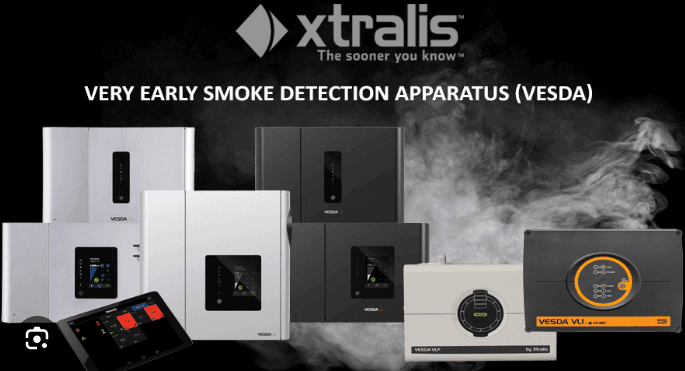
What is VESDA aspirating smoke detection?
VESDA is a family of aspirating smoke detectors that actively and continuously draw air from the protected area through a network of sampling pipes and analyse it for the earliest microscopic products of combustion. Rather than waiting for smoke to reach a ceiling-mounted point detector, VESDA brings the air to a highly sensitive laser detection chamber, delivering Very Early Warning Fire Detection (VEWFD) — often minutes to hours before smoke would otherwise be visible.
A defining VESDA strength is multi-level warning: each detector provides several independent alarm thresholds (typically Alert, Action, Fire 1 and Fire 2), so responders get a graduated warning and time to investigate before an evacuation-level event. VESDA’s wide sensitivity range does not degrade over time, and the systems are certified to EN 54-20 and listed by regulatory bodies worldwide.
There are two active generations: the long-established VESDA (Laser) range — VLP, VLS, VLC, VLF, VLI — and the current VESDA-E range (VEP, VEU, VES, VEA), which adds Flair detection, absolute calibration, Ethernet/WiFi connectivity and up to 40% greater coverage in high-airflow environments. VESDA-E is backward compatible with existing VESDA pipe networks and VESDAnet. As part of Honeywell, VESDA connects naturally with the Notifier fire ecosystem. (See our Notifier brand page.)
How aspirating smoke detection works
VESDA reverses the logic of traditional detection — it brings the air to the detector. The process runs continuously:
- Sampling — a pipe network with precisely sized sampling holes is routed across the protected area, into voids, or above/below ceilings and floors.
- Aspiration — an aspirator (fan) inside the detector continuously draws air from every hole back to the detector through one to four pipe inlets.
- Filtration — multi-stage filtration removes dust and dirt, and a clean-air barrier protects the optics so sensitivity stays stable over the detector’s life.
- Analysis — a short-wavelength laser detection chamber measures light scattered by any smoke particles; VESDA-E’s Flair technology uses analytics to reject nuisance sources.
- Multi-level response — up to four alarm thresholds per detector are signalled via relays, VESDAnet, Ethernet/WiFi or a fire panel, and airflow is supervised per pipe for blockages or breaks.
Pipe design is critical and is verified with Xtralis’ ASPIRE software, which calculates hole sizing, transport time and sensitivity class. Commissioning is accelerated by AutoLearn™, which observes the environment over a set period and automatically sets appropriate smoke and airflow thresholds. (For ASD fundamentals and how the platforms compare across brands, see our cross-brand Aspirating Smoke Detection guide.)
Core technologies: Flair, absolute calibration & ASPIRE
- Flair® detection technology — the laser-based detection engine at the heart of VESDA-E (VEU/VEP). Flair delivers up to 15× greater sensitivity than the legacy VESDA VLP, at least 3× better dust rejection, and up to twice the longevity while holding sensitivity stable over time.
- Absolute calibration — VESDA-E detectors are calibrated to an absolute reference, so measured smoke obscuration stays accurate for the life of the detector without periodic recalibration — a major serviceability advantage.
- Multi-stage filtration & clean-air barrier — a smart on-board filter tracks dust count and remaining filter life for predictable maintenance, while the clean-air barrier keeps the optics clean for lifetime performance.
- Referencing & analytics — VESDA can reference an external smoke source to compensate for ambient conditions (e.g. outside air drawn into a space), minimising nuisance alarms in variable environments.
- ASPIRE, VSC & VSM software — ASPIRE handles standards-compliant pipe network design and classification; Xtralis VSC (System Configurator) and VSM (System Manager) handle configuration, secondary monitoring and maintenance across the network.
The VESDA range and model line-up
The current portfolio scales from compact single-pipe units through to premium detectors covering thousands of square metres, plus addressable variants that pinpoint the source of smoke. Key models:
| Model | Positioning | Max coverage* | Min. Fire-1 sensitivity |
|---|---|---|---|
| VESDA-E VEU | Premium, highest-sensitivity detector; up to 80 Class A holes | Up to 6,500 m² | 0.001 %/m obs. |
| VESDA-E VEP | Mainstream all-rounder; 1-pipe or 4-pipe versions | Up to 2,000 m² | 0.005 %/m obs. |
| VESDA-E VES | Sector-addressable; up to 4 independent sectors per detector | Up to 2,000 m² | 0.001 %/m obs. |
| VESDA-E VEA | Pinpoint-addressable; microbore tubes to each sampling point | Up to 3,345 m² / 40 points | Point-addressable |
| VESDA VLI | Industrial/harsh environments; IP66 enclosure, intelligent filter | Up to 2,000 m² | Industrial-grade |
| VESDA VLF | LaserFocus: compact, small business-critical spaces | 250 or 500 m² | Very early warning |
*Coverage figures are maximums subject to ASPIRE design, EN 54-20 sensitivity class and local regulations. Higher-sensitivity (Class A) configurations reduce the effective area per detector, and VEU high-airflow coverage benefits from up to 80 Class A holes.
Key technical specifications (VESDA-E comparison)
The table below compares the four core VESDA-E detectors on the parameters that most affect design and specification.
| Parameter | VEU | VEP (4-pipe) | VES | VEA |
|---|---|---|---|---|
| Pipe inlets | 4 | 4 | 4 | 40 microbore |
| Linear pipe length | 400 m | 280 m | 400 m | 40 × 100 m |
| Branched pipe length | 800 m | 560 m | 800 m | N/A |
| Area coverage | 6,500 m² | 2,000 m² | 2,000 m² | 3,345 m² |
| Min. Fire-1 threshold | 0.001 %/m | 0.005 %/m | 0.001 %/m | 3 settings |
| Max Class A holes | 80 | 40 | — | 40 points |
| Addressability | No | No | 4 sectors | 40 points |
| Alarm thresholds | 4 levels | 4 levels | 4 / sector | Multi |
| Event log | 20,000 | 20,000 | 20,000 | 20,000 |
| IP rating | IP40 | IP40 | IP40 | IP40 |
| Connectivity | Ethernet/WiFi/VESDAnet | Ethernet/WiFi/VESDAnet | Ethernet/WiFi/VESDAnet | Ethernet/WiFi |
Source: Xtralis VESDA-E model comparison chart (Doc. 18327) and product data sheets. Figures are subject to change without notice — classify every design in ASPIRE.
Sensitivity classes, multi-level alarms & pipe design
VESDA’s hallmark is its ultra-wide sensitivity range. The premium VEU spans 0.001% to 20% obscuration/m, while the mainstream VEP spans 0.005% to 20%/m — orders of magnitude more sensitive than a point detector at the top end, yet able to sit at low sensitivity for dirty environments.
Under EN 54-20, a design is classified by per-hole sensitivity and transport time: Class A requires better than 1.5%/m per hole, Class B better than 3%/m, and Class C better than 8%/m. Because sensitivity is shared across holes, ASPIRE is used to balance hole count, pipe length and transport time against the target class. Each detector then layers up to four independent alarm thresholds (Alert, Action, Fire 1, Fire 2), with Day/Night settings to accommodate changing occupancy.
Applications and ideal use cases
VESDA has an unrivalled reference base across industries where earliest-possible detection, concealment or harsh conditions rule out point detectors:
- Data centres & telecom — high-airflow rooms where VEU’s extra Class A holes maintain very early detection.
- Warehouses & logistics — high ceilings where point detectors react too slowly.
- Cleanrooms & semiconductor — ultra-sensitive, non-intrusive detection in controlled environments.
- Heritage & landmark buildings — concealed pipes and small sampling points preserve aesthetics.
- Healthcare, prisons & hospitality — VEA pinpoints the exact room/cell of origin via microbore tubes.
- Industrial & harsh sites — VLI’s IP66 body and intelligent filter suit dusty, wet or aggressive environments.
- Cold stores & atria — stable sensitivity and long pipe runs handle large or challenging volumes.
- Transport & infrastructure — tunnels, metro and rolling stock with high reliability requirements.
Addressability: VES sectors & VEA pinpoint detection
Two VESDA-E models add addressability, closing the traditional ASD gap of “I know there’s smoke, but not exactly where.” VES divides a single detector’s pipe network into up to four independent sectors, each with its own alarm thresholds, so a large space can be sub-divided for faster threat localisation. VEA goes further, running individual microbore tubes to each sampling point (up to 40, expandable to 120) so smoke is pinpointed to a specific room, cabinet or location — combining ASD sensitivity with point-detector-style addressing, but with centralised test and maintenance.
Connectivity, software & commissioning
VESDA-E detectors ship with Ethernet and WiFi as standard, alongside the proprietary VESDAnet peer-to-peer network that ties multiple detectors and displays together and allows VESDA-E to co-exist with legacy VESDA units. Configuration, secondary monitoring and maintenance run through Xtralis VSC and VSM from a PC or tablet. Design is done in ASPIRE, and AutoLearn™ streamlines commissioning by automatically learning appropriate smoke and flow thresholds. A large on-board event log (20,000 events) supports diagnostics and audit.
Serviceability, field-replaceable parts & longevity
VESDA-E was designed to lower operating cost (OPEX). Its field-replaceable architecture means the filter, aspirator and chamber assembly can be swapped on site. The smart filter reports its dust count and remaining life so maintenance is predictable rather than reactive, and absolute calibration removes the need for periodic recalibration. Xtralis cites total-cost-of-ownership reductions of up to 15% (VEU/VEP) and up to 60% (VEA) versus the legacy equivalents, plus up to 40% greater coverage in high-airflow environments — meaning fewer detectors for the same space.
Ecosystem, accessories & related products
| Item | Function |
|---|---|
| PSU StaX | Integrated 24 V power supply with battery charger and standby-battery supervision for VESDA-E |
| VESDAnet | Proprietary peer-to-peer network linking detectors, displays and legacy VESDA units |
| ASPIRE | Pipe-network design and EN 54-20 classification software |
| Xtralis VSC / VSM | System Configurator and System Manager for setup, monitoring and maintenance |
| Field-replaceable modules | Filter, aspirator and chamber assembly serviceable on site |
| VESDA ECO | Adds gas detection + environmental monitoring to an existing VESDA pipe network |
| Remote displays / relays | Status annunciation and interface cards (relay/VESDAnet) for integration |
| Li-ion Tamer | Companion lithium-ion battery off-gas detection (BESS/EV/data-centre battery rooms) |
Integration & fire panel connection
VESDA integrates broadly. Detectors signal alarms and faults via configurable relays, VESDAnet, and (on VESDA-E) Ethernet/WiFi, and interface easily with fire alarm control panels (FACP) and fire suppression release systems. Because VESDA is vendor-neutral at the panel, it is frequently specified as the very-early-warning layer on top of an addressable fire system, and Honeywell offers integrations with popular commercial fire panels. As part of Honeywell, VESDA also connects naturally with Notifier and other Honeywell fire ecosystems.
Australian standards & AS 1851 servicing considerations
VESDA has deep roots in Australia (the technology originated there), and the range is widely specified locally. Aspirating detectors are governed at product level by the AS 7240 series (Australia’s adoption of ISO 7240 / EN 54), with AS 7240.20 covering aspirating smoke detectors. System design falls under AS 1670.1, and ongoing maintenance under AS 1851. VESDA’s EN 54-20 certification and broad regulatory listings generally underpin local acceptance — always confirm the current product listing for the Australian market. Practical AS 1851 servicing notes for VESDA ASD:
- Airflow verification — confirm airflow against the commissioned baseline; per-pipe flow supervision flags deviations, but network integrity and clear sampling holes must still be checked.
- Smoke test & transport time — verify detector response and that sample transport time remains within the ASPIRE design figure.
- Filter & contamination status — the smart filter reports dust count and remaining life; replace field-replaceable filters per the maintenance schedule.
- No recalibration drift — absolute calibration means sensitivity does not need periodic recalibration, simplifying AS 1851 routine service.
- Records & logs — retain the ASPIRE design, commissioning thresholds and the 20,000-event log as part of the maintenance record trail.
Confirm the current edition of each standard and the applicable Australian product approval with Honeywell/Xtralis or its local partner before finalising any design or maintenance regime.
Strengths and considerations
| Strengths | Considerations |
|---|---|
| Industry-standard brand with a vast reference base | Premium pricing vs point detection |
| Ultra-wide sensitivity (VEU to 0.001 %/m) | Pipe design needs ASPIRE + trained designers |
| Flair tech: strong dust rejection & longevity | Most models IP40 — harsh sites need VLI (IP66) |
| Addressability options (VES sectors, VEA pinpoint) | Dusty sites require filter upkeep |
| Absolute calibration — no recalibration drift | Full software suite has a learning curve |
| Ethernet/WiFi + field-replaceable parts | Confirm local AU approvals & support coverage |
| Backward compatible with legacy VESDA/VESDAnet | — |
Verdict: is the VESDA range worth it?
VESDA remains the benchmark against which other aspirating systems are measured. Its combination of ultra-wide, stable sensitivity, Flair dust rejection and longevity, multi-level warnings, unique addressability options (VES/VEA) and a huge installed base make it a safe, high-performance choice for data centres, cleanrooms, heritage buildings, healthcare and industrial sites. The VESDA-E generation meaningfully improves coverage, connectivity and total cost of ownership.
The trade-offs are those common to all premium ASD: a higher upfront cost than point detection and a real need for ASPIRE-based design and disciplined AS 1851 servicing. For small, simple, low-risk rooms, a compact VLF or point detectors may suffice; for critical, large or difficult spaces — especially where pinpoint location or the widest sensitivity range matters — VEU, VES and VEA deliver excellent long-term protection and value.
This review is an independent technical summary. VESDA®, VESDA-E and Flair® are trademarks of Xtralis / Honeywell. Specifications are sourced from Xtralis/Honeywell data sheets and comparison charts and are subject to change without notice — always verify current model availability, approvals and standards editions with Honeywell/Xtralis or an authorised partner before specifying or servicing equipment.
Standards & further reading
Frequently asked
VESDA stands for Very Early Smoke Detection Apparatus. It is a brand of aspirating smoke detectors, now part of Honeywell’s Xtralis portfolio, that draw air through sampling pipes and analyse it with a laser chamber for very early warning.
VESDA is the long-established laser range (VLP, VLS, VLC, VLF, VLI). VESDA-E is the current generation (VEP, VEU, VES, VEA) built on Flair detection with absolute calibration, Ethernet/WiFi, up to 40% more coverage in high airflow, and backward compatibility with existing VESDA pipe networks.
The VESDA-E VEU is the premium, highest-sensitivity detector, with an ultra-wide range down to 0.001 %/m obscuration and up to 80 Class A holes, covering up to 6,500 m².
VES is sector-addressable — it splits one detector’s pipe network into up to four sectors. VEA is pinpoint-addressable — it runs microbore tubes to each sampling point (up to 40, expandable to 120) to identify the exact location of smoke.
Flair is the laser detection engine in VESDA-E (VEU/VEP). It delivers up to 15× the sensitivity of the legacy VLP, at least 3× better dust rejection and up to twice the longevity, with sensitivity that stays stable over time.
VESDA-E uses absolute calibration, so sensitivity does not drift and periodic recalibration is not required, which simplifies maintenance.
VESDA detectors are certified to EN 54-20 (sensitivity classes A, B, C) with broad international listings. In Australia, aspirating detectors fall under AS 7240.20, with design to AS 1670.1 and maintenance to AS 1851.
All three are premium dual/laser aspirating platforms. VESDA leads on brand ubiquity, sensitivity range and addressability (VES/VEA); Siemens ASD+ emphasises very large single-device coverage within Cerberus PRO/Sinteso; Wagner TITANUS emphasises deep modularity and panel-agnostic integration. The right choice depends on coverage, existing panel, environment and whether pinpoint location is needed.
Run your whole trades business in one place
traqR does quoting, scheduling, invoicing, timesheets and compliance — built for Australian trades. Try it free for 14 days, no credit card required.