WAGNER TITANUS® Review — Aspirating Smoke Detection Range
WAGNER’s TITANUS® range is one of the world’s most established aspirating smoke detection (ASD) families — up to 2,000× more sensitive than point detectors, built on HPLS detection and LOGIC·SENS® false-alarm immunity. The full model line-up, specifications and AS 1851 servicing guide.
What is the WAGNER TITANUS® ASD system?
TITANUS® is WAGNER’s brand of aspirating smoke detection systems. Rather than waiting passively for smoke to reach a ceiling-mounted point detector, an aspirating system actively and continuously draws air from the protected area through a network of sampling pipes and analyses it for the smallest products of combustion. This delivers Very Early Warning Fire Detection (VEWFD) — an alarm during the incipient stage, often long before smoke is visible.
A defining characteristic of the TITANUS® family is modularity. WAGNER’s philosophy is that the customer “only gets the technology they need”: a base unit accepts one or two detector modules, and a broad catalogue of filters, accessories, cold-storage and low-noise (SILENT) variants lets a single platform be tailored precisely to each application. Detector modules and pipe designs are certified to EN 54-20 sensitivity classes A, B and C, and the range carries international approvals including VdS, UL, ULC, FM and AFNOR/NF.
Beyond detection, WAGNER is also known for OxyReduct® active oxygen-reduction fire prevention, which TITANUS® ASD frequently pairs with — but this review focuses specifically on the aspirating smoke detection range. In the Australian and New Zealand market, WAGNER TITANUS® is supplied and supported through Ampac (a Halma company). (See our Ampac brand page.)
How aspirating smoke detection works
Aspirating detection reverses the logic of traditional detection — it brings the air to the detector. The process runs continuously:
- Sampling — a pipe network with precisely sized aspiration holes is routed across the protected area, into cabinets, or concealed within suspended ceilings.
- Aspiration — a radial fan in the base unit creates negative pressure, continuously drawing air samples from every hole back to the detection chamber.
- Analysis — a sensitive optical detector (WAGNER’s HPLS light source) examines the air for the smallest smoke particles, benefitting from the “collection effect” where samples from many holes concentrate at one detector.
- Discrimination — LOGIC·SENS® fire-pattern recognition evaluates the signal against ambient conditions to separate genuine smoke from dust, exhaust gases, moisture and other nuisance sources.
- Response & monitoring — staged alarms (up to three thresholds per zone) are triggered and reported, while integrated airflow sensors constantly check the pipe network for blockages or breakages.
Each aspiration hole must meet at least the same detection requirement as a point detector, and effective smoke density increases with every additional hole — which is why a single TITANUS® PRO·SENS® can replace up to 64 point detectors. Correct pipe design is essential and is handled with WAGNER’s approved planning software (PipeXpress®), which calculates hole sizing and transport time to satisfy EN 54-20. (For ASD fundamentals and how the platforms compare across brands, see our cross-brand Aspirating Smoke Detection guide.)
Core technologies: HPLS, LOGIC·SENS® & W1
- HPLS (High Power Light Source) — a high-intensity light source giving the detection chamber exceptional sensitivity to the smallest smoke particles, allowing detection where other detectors reach their limits.
- LOGIC·SENS® — WAGNER’s patented fire-pattern recognition and signal processing. Instead of reacting to a raw particle count, it interprets the pattern and context of a signal to distinguish real fire from deceptive phenomena — the key to the range’s strong false-alarm immunity.
- LOGIC·SENS® PLUS & W1 (TITANUS REX®) — the 2025 TITANUS REX® generation introduces new W1 detection technology paired with an enhanced LOGIC·SENS® PLUS algorithm, evaluating data against ambient conditions for faster response, greater precision and lower energy consumption.
- PIPE·GUARD — patented airflow monitoring able to sense total-airflow changes as little as ±10%, satisfying EN 54-20’s requirement to detect a 20% airflow deviation and flagging blocked or broken pipes.
- ROOM·IDENT — an optional single-room identification feature that pinpoints which monitored room the smoke originated from — valuable in multi-room layouts such as hotels, cells or server suites.
The TITANUS® range and model line-up
WAGNER offers single- and dual-channel systems that scale from a single cabinet to very large halls. The table below summarises the core aspirating detectors in the current TITANUS® family.
| Model | Positioning | Max coverage* | Max sensitivity |
|---|---|---|---|
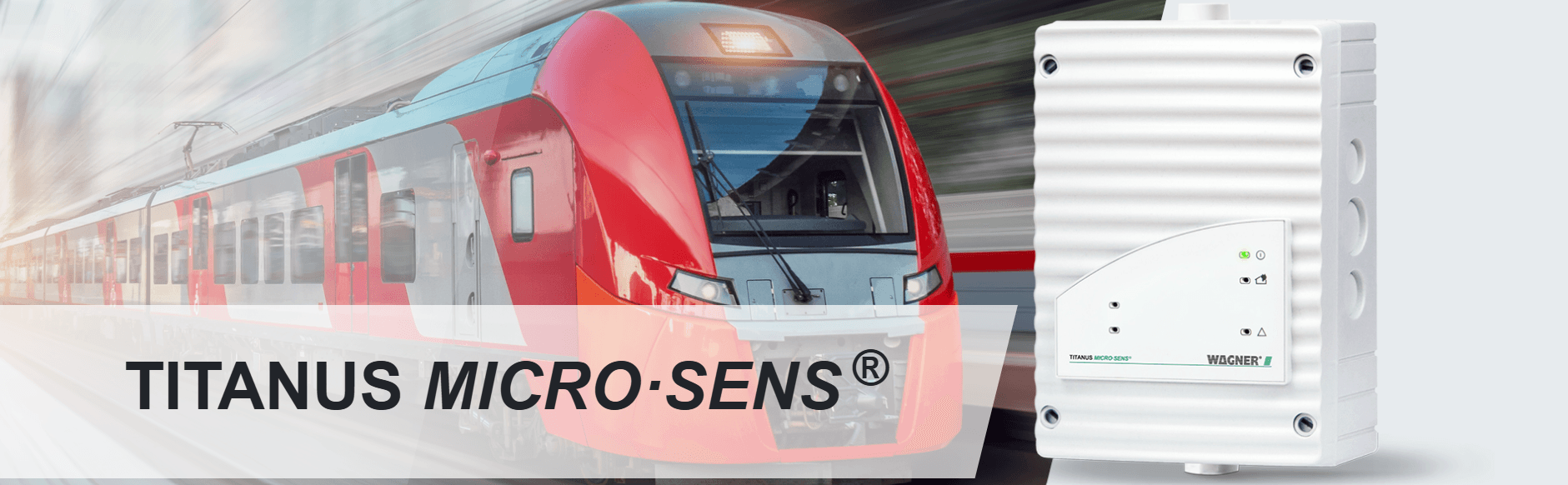
| MICRO·SENS® | Compact, economical entry unit (hotels, offices, cells, rail) | Up to 400 m² | 0.1 %/m obs. |
| FUSION® | Economical mid-tier for moderate performance needs | Up to 2 × 1,600 m² | High |
| PRO·SENS® | Best-selling universal detector; 1–2 zones, up to 3 alarms | Up to 5,760 m² (≈3,000 m²/zone) | 0.015 %/m obs. |
| TOP·SENS® | Full-featured: smoke-level display, day/night, Ethernet/SNMP | Up to 5,760 m² | 0.015 %/m obs. |
| SUPER·SENS® | Ultra-high-sensitivity for the most critical, low-particle areas | Sensitivity-limited | 0.0025 %/m obs. |
| RACK·SENS® | 19" format for servers & cabinets; optional integrated extinguishing | Cabinet / equipment | 0.1 %/m obs. |
| REX® 30/50/70 | 2025 next generation: W1 tech, LOGIC·SENS PLUS, energy-efficient | Shafts → hyperscale DC | High (VdS certified) |
*Coverage figures are maximums subject to EN 54-20 sensitivity class, national regulations and pipe design. Higher-sensitivity (Class A) configurations reduce the effective area per detector, and regional data sheets may quote slightly different figures (e.g. 6,000 m² in some markets).
Key technical specifications (TITANUS® PRO·SENS®)
The PRO·SENS® is WAGNER’s flagship all-rounder and a good reference point for the range. Representative specifications:
| Parameter | TITANUS® PRO·SENS® |
|---|---|
| Detector modules (zones) | 1 or 2 (dual-channel) |
| Max coverage | Up to 5,760 m² per system (≈3,000 m² per zone) |
| Max fire-alarm sensitivity | 0.015 %/m obscuration |
| Alarm thresholds per zone | Up to 3 (tiered alarm concept) |
| Aspiration holes | Up to 1 × 100 or 2 × 72 |
| Point detectors replaced | Up to 64 |
| Max pipe length | Up to ~560 m (config-dependent, EN 54-20) |
| Pipe diameter | 25 mm outer (ABS / PVC) |
| Operating voltage | 24 V DC (14–30 V DC) |
| Current (quiescent / alarm) | ≈200 / 210 mA (lower in SILENT version) |
| Noise level | From 23 dB(A) in SILENT version |
| Operating temperature | -20 to +60 °C (Cold Storage: -40 to +60 °C) |
| Humidity | 10–95 % RH (non-condensing) |
| Dimensions (W×H×D) | 200 × 292 × 113 mm |
| Protection category | IP20 (optional IP52) |
| Airflow monitoring | PIPE·GUARD (senses ±10% total-airflow change) |
| Output relays | Programmable (contact load per data sheet) |
| Standards | EN 54-20 Classes A, B, C; EN 54-17 (as applicable) |
| Approvals | VdS; UL / ULC / FM / AFNOR on applicable variants |
| Variants | Standard · SILENT · Cold Storage · Network |
Figures are representative and drawn from WAGNER PRO·SENS® data sheets; exact values vary by variant and revision and are subject to change without notice.
Sensitivity classes, detector modules & pipe design
TITANUS® sensitivity is set by the choice of detector module and the pipe design. WAGNER offers modules across a wide sensitivity band — for example PRO·SENS® modules range from around 2 %/m down to 0.015 %/m obscuration, while the specialised SUPER·SENS® reaches an extraordinary 0.0025 %/m for the most demanding, ultra-clean environments.
Under EN 54-20, an aspirating system is classified into fire sensitivity Class A (highest), B or C. The class achievable depends on the number of aspiration holes and the per-hole sensitivity: more holes spread the sensitivity, so designers balance hole count, pipe length and module sensitivity to hit the target class. WAGNER specifies a minimum 4 m and maximum 12 m spacing between aspiration holes on PRO·SENS®, and airflow monitoring must detect a 20% change to comply.
Applications and ideal use cases
TITANUS® aspirating detectors have a long track record across industries where earliest-possible detection, concealment, or harsh conditions rule out point detectors:
- Data centres & server rooms — high airflow demands very early detection; RACK·SENS® protects individual 19" cabinets.
- Warehouses & logistics — high ceilings where point detectors react too slowly.
- Cold stores & deep-freeze — Cold Storage variants operate down to -40 °C (REX® to -32 °C).
- Clean rooms & semiconductor — high-sensitivity SUPER·SENS® for ultra-clean, low-particle spaces.
- Heritage & architecturally sensitive buildings — nearly invisible detection with concealed pipes and ceiling-integrated sampling points.
- Elevator/lift shafts & hard-to-reach voids — a centralised detector allows maintenance without accessing the shaft.
- Rail vehicles & transport — many modules are approved for rolling-stock applications.
- Noise-critical spaces — SILENT variants operate from just 23 dB(A) for offices, hotels and studios.
- Dusty / harsh industry — a filter portfolio (coarse to fine) plus LOGIC·SENS® maintains reliability in polluted air.
Extreme environments: Cold Storage, SILENT & harsh sites
A standout strength of the TITANUS® range is its adaptability to hostile conditions. Cold Storage versions keep detecting reliably in deep-freeze facilities down to -40 °C, using pipe accessories and clearing clips that resist icing. SILENT versions drop the fan noise to as low as 23 dB(A) for acoustically sensitive rooms. For polluted or dusty environments, WAGNER’s graduated filter portfolio (LF-AD coarse through fine filters) removes particles before they reach the detector, cutting false alarms and extending both maintenance intervals and detector service life.
Digital tools: PipeXpress®, ServiceXpress & diagnostics
WAGNER supports the hardware with connected software. TITANUS® PipeXpress® (and PipeXpress® PLUS for REX®) provides wizard-guided, standards-compliant project planning and pipe configuration, enabling fast, secure, plug-and-play commissioning. TITANUS® ServiceXpress and the diagnostics tools streamline maintenance of centrally installed detectors — often without interrupting operation — while configuration software gives access to sensitivity, airflow and relay settings, plus event logging and optional data logging via Ethernet (TCP/IP) / SNMP on networked variants.
Modularity, filters & maintenance
Modularity is the commercial heart of the TITANUS® proposition. A base unit can carry one or two detector modules, be upgraded with network cards, extra alarm indicators, filters and cold/silent options, and be matched to the exact sensitivity class required — so operators avoid paying for capability they don’t need. Because the detector sits centrally, servicing does not require access to the monitored ceiling or shaft: technicians work at one accessible location, reducing inspection and maintenance costs. Replaceable filters and airflow diagnostics support condition-based maintenance and long service life.
Detector modules & key accessories
| Item | Function |
|---|---|
| Detector modules (DM-TP…) | Interchangeable modules setting the sensitivity band and alarm stages per zone |
| LF-AD filter series | Graduated air filters (coarse → fine) to separate dust, fibres, pollen and fine particles |
| Aspiration reducing foils | Finely graduated opening diameters for defined air sampling; optional clearing clips |
| SILENT option | Low-noise operation from 23 dB(A) for acoustically sensitive areas |
| Cold Storage option | Operation to -40 °C with anti-icing pipe accessories |
| Network card (Ethernet/SNMP) | Remote monitoring, data logging and integration (TOP·SENS® / networked variants) |
| ROOM·IDENT | Single-room fire localisation across multiple monitored rooms |
| Remote alarm indicators | External response/alarm displays (e.g. DJ-1191 / DJ-1192) |
| Extinguishing option (RACK·SENS®) | Integrated or external extinguishing-agent containers for cabinet firefighting |
Integration & fire panel connection
A major practical advantage of TITANUS® is that it is panel-agnostic. Detectors connect to virtually any fire alarm control panel via potential-free (dry) relay contacts, and to WAGNER and selected third-party systems via direct bus connection. Networked variants add Ethernet (TCP/IP) / SNMP for building-management integration and remote diagnostics. This open connectivity lets TITANUS® be specified as the very-early-warning layer on top of an existing conventional or addressable fire system, rather than locking the client into a single ecosystem — a notable contrast with tightly loop-integrated competitor detectors such as the Siemens ASD+.
Australian standards & AS 1851 servicing considerations
For Australian fire protection professionals, aspirating detectors are governed at product level by the AS 7240 series (Australia’s adoption of ISO 7240 / EN 54), with AS 7240.20 covering aspirating smoke detectors. System design falls under AS 1670.1, and ongoing maintenance under AS 1851. WAGNER’s EN 54-20 certification generally underpins local acceptance, but always confirm the specific product listing and current distribution/support arrangements for the Australian market. Practical AS 1851 servicing notes for TITANUS® ASD:
- Airflow verification — confirm airflow against the commissioned baseline; PIPE·GUARD flags deviations, but technicians must still verify network integrity and that aspiration holes are clear.
- Smoke response & transport time — test detector response and confirm sample transport time remains within the design figure.
- Filter servicing — inspect/replace LF-AD filters in dusty environments to sustain sensitivity and avoid nuisance alarms.
- Central maintenance advantage — the centrally located detector allows most servicing without accessing ceilings, shafts or cold rooms, lowering AS 1851 routine-service labour.
- Records & diagnostics — retain the PipeXpress® design, commissioning sensitivity/airflow settings and event/data logs as part of the maintenance record trail.
Confirm the current edition of each standard and the applicable Australian product approval with WAGNER or its local partner before finalising any design or maintenance regime.
Strengths and considerations
| Strengths | Considerations |
|---|---|
| Extremely high sensitivity (down to 0.0025 %/m) | Higher upfront cost vs point detection |
| LOGIC·SENS® — excellent false-alarm immunity | Pipe design needs WAGNER-approved tools/expertise |
| Deep modularity — pay only for needed capability | Many variants/modules — specification takes care |
| Panel-agnostic (dry contacts + bus/Ethernet) | IP20 base — indoor/controlled mounting |
| Extreme-environment variants (-40 °C, 23 dB(A)) | Dusty sites require filter upkeep |
| Central servicing lowers maintenance cost | Confirm local AU approvals & support coverage |
| Broad model range from cabinet to hyperscale | — |
Verdict: are WAGNER TITANUS® systems worth it?
WAGNER TITANUS® is one of the strongest and most mature aspirating platforms available. Its combination of class-leading sensitivity, proven LOGIC·SENS® false-alarm immunity, genuine modularity, panel-agnostic integration and specialised variants for cold, quiet and dirty environments make it a go-to choice for data centres, cold stores, heritage buildings, clean rooms and industrial sites. The new energy-efficient TITANUS REX® generation signals continued investment in the range.
The trade-offs are those common to all premium ASD: a higher upfront cost than point detection and a real need for competent, tool-based pipe design and disciplined AS 1851 servicing. The breadth of models and modules is a strength but demands careful specification. For small, simple, low-risk rooms, a compact MICRO·SENS® or point detectors may suffice; for critical or difficult spaces, the PRO·SENS®, TOP·SENS®, SUPER·SENS® and REX® deliver excellent long-term protection and value.
This review is an independent technical summary. TITANUS® and related names are trademarks of WAGNER Group GmbH. Specifications are sourced from WAGNER data sheets, manuals and press materials and are subject to change without notice — always verify current model availability, approvals and standards editions with WAGNER or an authorised partner before specifying or servicing equipment.
Standards & further reading
Frequently asked
TITANUS® is WAGNER’s range of aspirating smoke detectors (ASD) that continuously draw air through sampling pipes and analyse it for the earliest smoke particles, providing very early warning fire detection.
They are reported to be up to 2,000 times more sensitive than conventional point detectors. PRO·SENS® reaches 0.015 %/m obscuration, and the specialised SUPER·SENS® reaches 0.0025 %/m.
LOGIC·SENS® is WAGNER’s patented fire-pattern recognition and signal processing that distinguishes genuine smoke from dust, steam and exhaust gases — the main reason for the range’s strong false-alarm immunity.
MICRO·SENS® for small/economical spaces, FUSION® for moderate needs, PRO·SENS® as the universal all-rounder, TOP·SENS® for networked/large sites, SUPER·SENS® for ultra-high sensitivity, RACK·SENS® for cabinets, and the new REX® 30/50/70 across shafts to hyperscale data centres.
Yes. TITANUS® detectors interface with virtually any fire alarm control panel via potential-free (dry) contacts, and offer bus and Ethernet/SNMP options on networked variants, making them largely panel-agnostic.
Yes. Cold Storage variants operate down to -40 °C (TITANUS REX® to -32 °C), with pipe accessories that resist icing.
They are certified to EN 54-20 (sensitivity classes A, B and C) with approvals such as VdS, UL, ULC, FM and AFNOR. In Australia, ASD falls under AS 7240.20, with design to AS 1670.1 and maintenance to AS 1851.
Both are premium dual-technology aspirating platforms. WAGNER emphasises deep modularity, ultra-high sensitivity options and panel-agnostic integration; Siemens ASD+ emphasises very large single-device coverage and tight integration into its Cerberus PRO / Sinteso ecosystem. The right choice depends on coverage, existing panel and environment.
Run your whole trades business in one place
traqR does quoting, scheduling, invoicing, timesheets and compliance — built for Australian trades. Try it free for 14 days, no credit card required.