“Test and tag” gets talked about as if it’s a blanket legal rule for every workplace. The reality is a bit more nuanced. Here’s the plain-English version.
What is test and tag?
It’s the in-service safety inspection and testing of electrical equipment, carried out to the standard AS/NZS 3760 (current edition AS/NZS 3760:2022). The process is a visual inspection for damage, an electrical test with a portable appliance tester, and then a tag recording the result and the next test date.
Is it legally required?
Under work health and safety law, a business must ensure its electrical equipment is safe and properly maintained, and that duty is universal. But there’s no blanket law saying you must “tag every appliance.” AS/NZS 3760 is the recognised way to meet the duty, and it becomes effectively mandatory in higher-risk settings, most notably construction and demolition sites.
How often?
Intervals are risk-based and come from the standard, not a single legal number. As a general guide: construction and demolition sites every 3 months, workshops and other “hostile” environments more frequently, and low-risk offices up to 5 years. The dirtier or rougher the environment, the more often you test.
Queensland and Victoria are different
Queensland is the outlier: its Electrical Safety Regulation sets specific statutory testing intervals (for example, equipment used in manufacturing), and to provide test and tag as a service to other businesses you need a Restricted Electrical Contractor’s Licence. Victoria runs its own OHS framework rather than the harmonised WHS laws. Always check your own state regulator.
Who can do it?
You generally don’t need to be a licensed electrician to test and tag. It can be done by a “competent person” who’s been trained to use the testing equipment (often a one-day course). Actual electrical repairs, though, always require a licensed electrician; a tester can fail and quarantine a faulty item but can’t fix it.
What goes on the tag
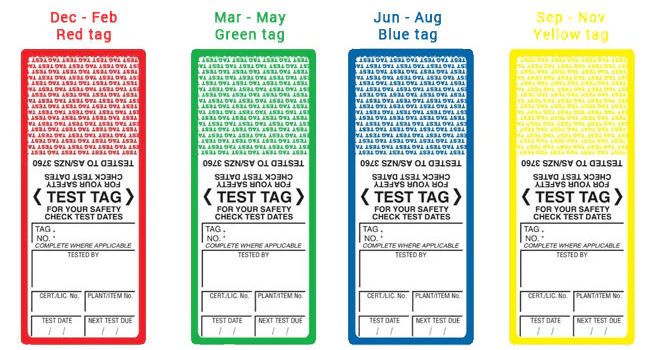
A compliant tag (and the testing register behind it) records the tester’s name or ID, the test date, the next test due date, a pass/fail result, and an identifier for the item. Failed gear is removed from use and tagged out of service.