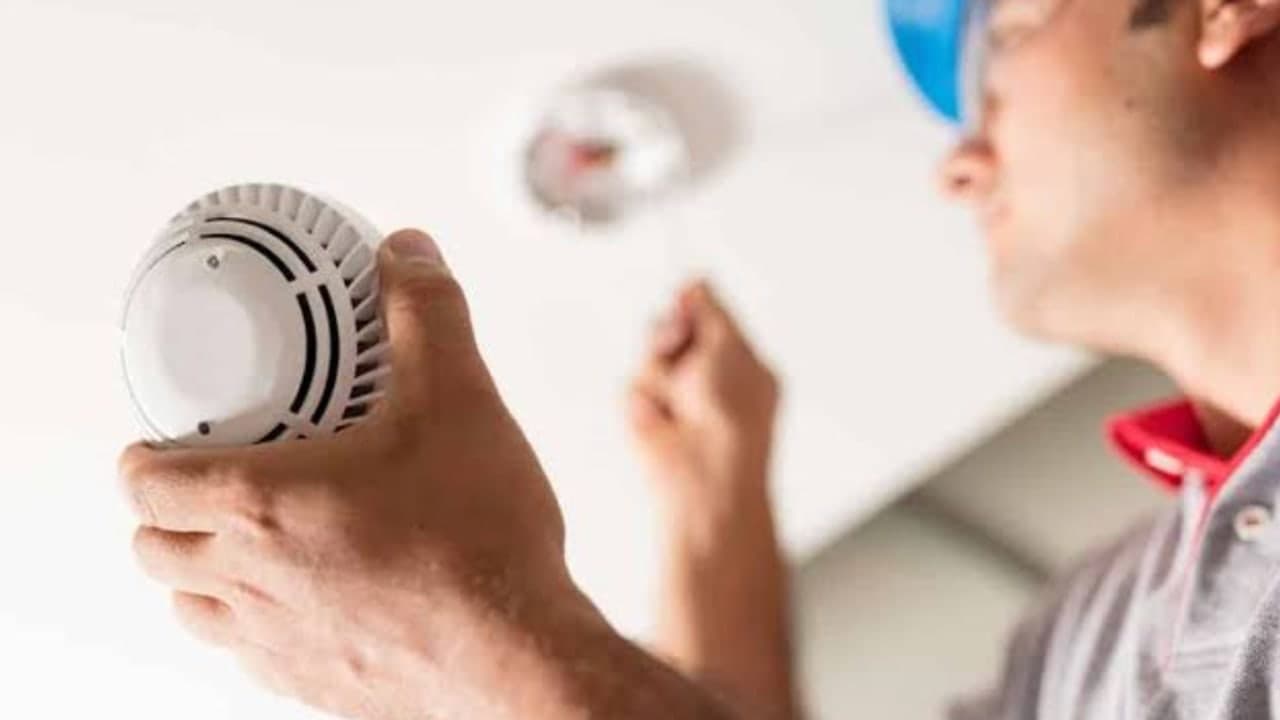
Most writing about fire protection assumes a big building: a panel, a pump room, a schedule of measures and a single point of contact. There is a whole other half of the industry that looks nothing like that. It is hundreds of apartments and houses, each with two or three smoke alarms, each with a tenant who may or may not be home, managed through agents who want one certificate per property and no phone calls.
Technically it is the simplest work in fire protection. Commercially it is the hardest to get right, because the margin on a single visit is small enough that one wasted trip erases it, and the difference between a profitable portfolio and an unprofitable one comes down to scheduling, access and data quality rather than anything a technician does with a screwdriver.
This guide covers the two different systems that coexist in residential buildings, what the law asks of landlords around the country, the ten-year replacement rule, what a defensible service visit looks like, the access problem at scale, and how to price and run a portfolio so that volume works for you rather than against you.
Two systems, one building
In an apartment building there are usually two entirely separate fire detection arrangements, governed by different standards, maintained on different cycles and paid for by different people. Getting this boundary right is the first thing to establish on any residential job, because it determines who you invoice and what you are responsible for.
| Alarms inside the unit | Building detection system | |
|---|---|---|
| Standard | AS 3786 stand-alone smoke alarms | AS 1670.1 fire detection and alarm system |
| Where | Inside each sole-occupancy unit | Common property: corridors, lobbies, plant rooms, car park |
| Maintained under | Tenancy law and building regulations | AS 1851-2012, as a fire safety measure |
| Who pays | The owner or landlord of the unit | The owners corporation or body corporate |
| Typical cycle | Annual check, with the tenancy triggering extra checks | Monthly to yearly routine under the standard |
| Evidence produced | A per-property certificate or report | Service records, condition report and the annual statement |
The two can be physically connected. In many buildings the alarms inside the units are interconnected with each other but not with the building system, so a unit alarm sounds locally without putting the building into alarm. In others there is an interface, and a unit detector does report to the panel. Establish which arrangement exists before you touch anything, because testing an alarm that reports to a monitored panel without notifying anyone produces an unnecessary brigade attendance and an invoice the client will remember.
What the law asks, in outline
Smoke alarm obligations sit in building regulations and tenancy law rather than in AS 1851, which means they differ by state and change more often than the fire standards do. The shape of the obligation is broadly consistent, and the detail is not.
| Jurisdiction | The shape of the obligation |
|---|---|
| New South Wales | Landlords must ensure smoke alarms are installed and working, check them at least annually, replace batteries as required, and repair or replace a failed alarm within a short, defined period after being told about it. |
| Queensland | The most prescriptive regime in the country: interconnected photoelectric alarms in every bedroom, in hallways connecting bedrooms, and on each storey. Required in rental and sold properties from 1 January 2022, and in all other domestic dwellings from 1 January 2027. Lessors must test within a defined period before the start of each tenancy. |
| Victoria | Rental providers must ensure alarms are installed and in working order, test them annually, and give renters information about their operation, alongside the general building regulation requirements. |
| South Australia | Alarms are required in all residential premises, with mains-powered or long-life sealed lithium alarms required in rental properties and on change of ownership. |
| Western Australia | Mains-powered alarms are required on sale, lease or hire of a dwelling, with long-life sealed alarms permitted only where mains power is not available. |
| Tasmania, ACT and Northern Territory | Alarms are required in all dwellings, with landlord duties to install, test and maintain set out in tenancy law and building regulations. |
Treat that table as orientation, not as advice. If you are selling a compliance service, the exact obligation in the state you operate in is part of the product, and it is worth having the current regulation and the regulator guidance on file rather than relying on a summary. It changes; Queensland has been through a staged rollout, and other states have revisited their rules more than once in the last decade.
The ten-year rule
Smoke alarms wear out. The sensing chamber accumulates dust and contamination, the electronics age, and sensitivity drifts. Manufacturers and AS 3786 recognise this with a service life, and the settled industry practice is replacement ten years from the date of manufacture, which is printed on the alarm itself.
For a portfolio business this is the single most valuable data point you can collect. An alarm register with manufacture dates turns into a forward replacement plan: how many alarms fall due next year, in which properties, at what cost. Agents and owners respond well to that, because it converts an unpredictable cost into a budget line. Without it, every replacement is an unexpected invoice and an argument.
- Record the manufacture date at every visit, not just the test result.
- Flag alarms in their final year so the next visit can replace rather than test and return.
- Where an alarm has no legible date, treat it as end of life. An undated alarm cannot be shown to be within its service life.
- Replace like for like or better, and record what was installed, where, and when.
Photoelectric, ionisation and what to recommend
Photoelectric alarms respond faster to the smouldering, smoky fires that kill people in their sleep: bedding, upholstery, electrical faults in wall cavities. Ionisation alarms respond faster to fast, flaming fires but are also the type most likely to be triggered by cooking, which leads to the worst outcome of all, an alarm removed from the ceiling by a frustrated occupant.
Fire services around the country recommend photoelectric alarms, Queensland mandates them, and the practical advice to any owner replacing an alarm is the same everywhere: fit photoelectric, interconnect where you can, and put them where people sleep. Ionisation alarms contain a small radioactive source, so dispose of removed units through the correct waste stream rather than in a general waste bin.
Where alarms actually have to go
Placement is where most residential non-compliance hides, and it is the part an agent or owner is least equipped to judge. An alarm that works perfectly in the wrong place is still a finding, and it is one worth explaining clearly rather than noting in shorthand.
- On every storey, including levels with no bedrooms, and in the path of travel occupants would use to leave.
- Outside sleeping areas, and in Queensland and in any building that meets the current requirements, inside each bedroom as well.
- Away from the corners where walls meet ceilings, because air moves slowly in that dead space and smoke reaches the sensing chamber late.
- Clear of air conditioning outlets, ceiling fans and open windows, which can push smoke away from the alarm entirely.
- Not directly outside a bathroom or immediately adjacent to a cooktop, where steam and cooking fumes generate nuisance alarms that lead to the alarm being disabled.
- Where a wall-mounted alarm is used, within the band below the ceiling that the manufacturer specifies rather than at head height.
Renovations are the usual cause of a bad placement: a wall goes up, a room becomes two, a kitchen moves, and the alarm that was correctly located five years ago is now in the wrong room or too close to the stove. Photograph the placement at every visit, because it is the only way to show when it changed and who changed it.
Start-of-tenancy checks
Alongside the annual cycle, most jurisdictions require a check when a tenancy begins, and those requests arrive with almost no notice. A property becomes vacant, a new tenancy is signed, and the agent needs a check done before the handover date.
These are the visits that wreck a planned route, and they are also the visits agents judge you on, because the deadline is real and visible to them. Handle them as a separate service line with its own turnaround commitment and its own price, and build a little slack into each week to absorb them. A contractor who reliably turns a start-of-tenancy check around in two working days will hold a rent roll against cheaper competitors indefinitely.
What a defensible visit looks like
The visit is short. That is exactly why it needs to be consistent, because the only thing protecting you a year later is the record.
- Confirm the property, the alarm count expected, and any known access arrangement before you knock.
- Locate every alarm and check its position against the requirements: bedrooms and paths of travel as applicable, correct distance from walls, corners, vents and light fittings.
- Record the manufacture date on each alarm.
- Test with the test button, and where your scope requires it, with an approved aerosol test agent to prove the sensing chamber responds rather than just the electronics.
- Check the sound level is audible where it needs to be, particularly through a closed bedroom door.
- Test interconnection where alarms are interconnected: one alarm triggered, all alarms sound.
- Replace batteries where the alarm uses replaceable batteries, and record it.
- Clean the alarm and check for insects, dust and paint.
- Photograph each alarm in place, with its location identifiable.
- Produce a per-property record: alarms found, tests performed, results, replacements, defects, and anything you could not do.
That final step is the deliverable. Agents do not want a job sheet, they want a document they can put on the tenancy file and produce if something happens. Make it clean, consistent and per-property, and you will be asked to quote on the rest of the rent roll.
The access problem, and what it really costs
Every conversation about portfolio work eventually comes back to the same thing: getting in. A visit that cannot be completed still costs travel, time and administration, and the economics are unforgiving.
Consider a job priced at eighty dollars per property. One completed visit is profitable. A visit where nobody answers, followed by a second attempt, followed by a third that finally succeeds, has consumed three lots of travel and two lots of administration for the same eighty dollars. Two of those in every ten properties is the difference between a healthy portfolio and one that quietly loses money all year.
- Agree the notice procedure with the agent in writing, including who sends it, how far ahead, and what happens if the tenant does not respond.
- Agree a re-attendance fee for failed access from the outset. It changes agent behaviour more than any amount of complaining.
- Book by area, not by due date, so a day is a suburb rather than a drive across the city.
- Offer a time window and a way for tenants to confirm or reschedule. A tenant who has confirmed is a tenant who is home.
- Use key access through the agent where the tenancy allows it and the agent will support it. It is the single biggest fix available.
- Set a limit: two attempts, then the property goes back to the agent as unable to access, with a written record of both attempts.
- Report no-access properties to the agent immediately, not at the end of the cycle. The obligation is the owner, and your evidence that you tried is what protects them and you.
Running a portfolio profitably
Density beats everything
The unit economics of this work are dominated by travel. Twenty properties in one suburb is a good day; twenty properties spread across a metropolitan area is a bad week. When you quote a new rent roll, look at where the properties actually are before you look at how many there are, and be prepared to decline the outliers or price them separately.
Price the exceptions, not just the visit
- Standard annual check, per property, with a defined alarm count included.
- Additional alarms above that count, per alarm.
- Alarm replacement, supplied and fitted, priced separately.
- Re-attendance after failed access.
- Start-of-tenancy checks, which arrive unpredictably and at short notice.
- After-hours or weekend attendance where a portfolio demands it.
- Ladder or height access where ceilings are high, which is more common than agents expect.
The data is the asset
A portfolio contract is worth far more in year three than in year one, because by then you know every property: how many alarms, where they are, how old they are, whether the ceiling needs a ladder, whether the tenant works nights, and which properties will be a problem. That knowledge is what lets you cut a day of driving out of the cycle and what makes the contract hard for a competitor to take from you. It only exists if somebody records it at every visit, which means the field app has to make recording it faster than not recording it.
Do not win on price alone
This is the part of fire protection most vulnerable to undercutting, because the service looks like a commodity from the agent side of the desk. The defence is not a lower number, it is a better deliverable: a consistent per-property certificate, a forward replacement plan the owner can budget, immediate notification of no-access properties, and a portal the agent can search when a tenant complains. Compete on the paperwork, because that is the part the agent actually consumes.
Where the building system fits
In Class 2 apartment buildings the common property detection and alarm system is a fire safety measure like any other: installed to AS 1670.1, serviced under AS 1851-2012, and assessed for the building annual statement. That work belongs to the owners corporation and is a separate contract from the unit alarms, even when the same contractor does both.
Being the contractor for both is a strong position, because you are the only party who sees the whole building. It also creates an obligation to be clear in your reporting about which hat you are wearing. Keep the records separate: a strata committee reading a building service report should not have to work out which findings relate to somebody private apartment, and an owner reading a unit certificate should not be billed for common property work.
Frequently asked questions
Are smoke alarms in apartments covered by AS 1851?
Stand-alone alarms inside a sole-occupancy unit are generally governed by building regulations and tenancy law rather than AS 1851. The building detection and alarm system on common property is a fire safety measure serviced under AS 1851-2012. They are separate obligations with separate payers.
How often do smoke alarms have to be checked in a rental property?
At least annually in most jurisdictions, with additional checks triggered by events such as the start of a tenancy. The precise requirement, including who must do it and how quickly a failure must be rectified, is set by the tenancy law in that state.
When does a smoke alarm need replacing?
Ten years from the date of manufacture is the accepted service life, and the date is printed on the alarm. An alarm with no legible date should be treated as end of life, because you cannot demonstrate it is still within its service life.
Photoelectric or ionisation?
Photoelectric. They respond faster to smouldering fires and are far less prone to cooking nuisance alarms, which is what leads occupants to disable them. Queensland mandates photoelectric, and fire services around the country recommend them.
What do we do when a tenant will not give access?
Follow the agreed notice procedure, attempt the agreed number of visits, document each attempt with date and time, and report the property to the agent as unable to access in writing. The obligation sits with the owner; your evidence that you attempted access is what protects everybody.
Can we test a unit alarm that is connected to the building fire panel?
Only with the correct isolation and notification. Establish the interface arrangement and the monitoring provider first. An unnecessary brigade attendance is expensive and entirely avoidable.
Is this work worth doing at all?
It can be very good business, but only with density, disciplined access management, and a deliverable the agent values. Portfolios are sticky, the revenue is predictable, and the replacement cycle produces a steady second income stream. Priced as a commodity and run without data, it is a treadmill.
Sources and further reading
- AS 3786 Smoke alarms using scattered light, transmitted light or ionization, Standards Australia
- Smoke alarms, NSW Fair Trading
- Smoke alarms, Queensland Fire Department
- Smoke alarms in rental properties, Consumer Affairs Victoria
- AS 1670.1 Fire detection, warning, control and intercom systems, Standards Australia