Special hazard systems are the highest-value, lowest-volume work in fire protection. One data centre suppression system can be worth more in annual service revenue than fifty hose reels, and a single missed cylinder test date can wipe out the margin on the contract for three years.
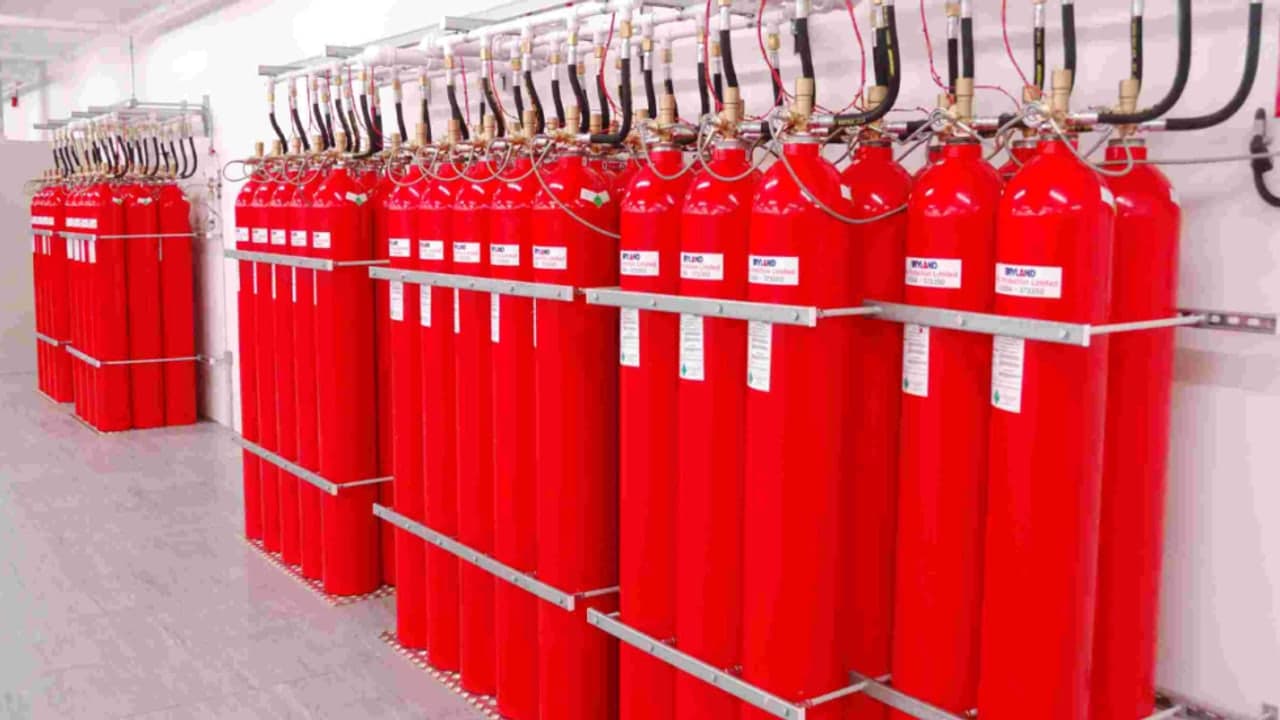
They are also the systems most often inherited without documentation. The building changes hands, the contractor changes, and what remains is a bank of red cylinders in a room nobody opens, protecting a space whose walls have been drilled through a dozen times since commissioning.
This guide covers what counts as a special hazard system, the standards and licensing behind them, what routine servicing involves, why room integrity is the test that actually matters, the long-interval items that destroy contract margins when they are not planned for, kitchen wet chemical systems, the safety issues unique to CO2, and how to price the work properly.
What counts as a special hazard system
The term covers any system protecting a risk that water is unsuitable for, or where the asset being protected is worth more than the building around it.
| System type | Agent | Typical protected risk |
|---|---|---|
| Clean agent, halocarbon | FK-5-1-12 or HFC-227ea | Data halls, comms rooms, switch rooms, control rooms |
| Clean agent, inert gas | Nitrogen, argon or blends | Data centres and archives where a halocarbon is unsuitable |
| Carbon dioxide | CO2, total flooding or local application | Generator rooms, industrial plant, paint lines |
| Kitchen wet chemical | Potassium-based wet chemical | Commercial kitchen cooking lines, hoods and ducts |
| Foam | AFFF or fluorine-free alternatives | Flammable liquid storage, loading areas, hangars |
| Water mist | Water, high or low pressure | Machinery spaces, turbines, some heritage buildings |
| Dry chemical | Powder | Industrial local application, fuel dispensing |
They share three characteristics that change how you service them. They discharge once, so the thing you most want to prove is the thing you cannot test. Their performance depends on the enclosure as much as on the hardware. And the agent inside them is regulated in its own right, quite apart from fire safety law.
The standards and the licences
- AS 4214 covers gaseous fire extinguishing systems, aligned with the ISO 14520 series, and is the design, installation and commissioning standard for clean agent and inert gas systems.
- AS 1851-2012 covers the routine service of special hazard systems, with the activities and intervals set out in its tables.
- AS 1670.1 covers the detection and alarm system that initiates the release, including the cause and effect logic behind a two-detector confirmation.
- Gas cylinders are subject to the gas cylinder standards for periodic inspection and hydrostatic testing, with the test date stamped on the cylinder itself.
- Pre-engineered kitchen systems are typically listed to an international standard such as UL 300 and serviced to the manufacturer manual alongside the AS 1851 requirements.
Why these systems are different
The enclosure is part of the system
A total flooding system works by achieving a design concentration of agent throughout a protected space and holding it there long enough for the fire to be extinguished and for the risk of reignition to pass. That depends on the room being reasonably tight. The system can be perfect and still fail if the agent leaks out through cable penetrations, under doors, through a ceiling void or into an adjacent space.
This is what makes special hazard work different from every other system in the standard. You are not only maintaining equipment. You are maintaining an assumption about a building that other trades keep quietly invalidating every time they run a new cable.
The main function cannot be tested
You cannot prove a suppression system will flood a room without flooding the room, and nobody is going to fund that. Everything the service does is therefore indirect: verifying the agent is present in the right quantity, verifying the release path will work, verifying the detection and control logic initiates correctly, and verifying the enclosure still holds. Each of those is a proxy, and each has to be done properly, because the whole chain of evidence is made of proxies.
Discharge has consequences for people
An accidental discharge is expensive, disruptive and, with CO2, potentially lethal. That shapes the whole service procedure: lock off before working, understand the release circuit before touching it, and treat the abort, manual release and time delay arrangements as safety-critical items rather than accessories.
The routine service
The frequent checks
- Agent container pressure, where the agent is superpressurised, read against the temperature-compensated chart rather than a single number.
- Container and bracket condition: corrosion, physical damage, secure mounting, and nothing stored against or on top of the bank.
- Discharge pipework and nozzles: fitted, correct, unobstructed, caps in place where required, and nothing new hanging off the pipework.
- Control panel status: normal, no faults, batteries healthy, and the release circuit in the state it should be.
- Manual release and abort stations: accessible, unobstructed, correctly labelled, and their covers intact.
- Warning signage at every entry to the protected space, and the discharge warning devices in place.
- The protected space itself: what has changed, what has been added, and whether the room is still the room the system was designed for.
The yearly work
- Weigh or level-check every container against its commissioning mass, to confirm no loss of agent. A container outside its allowable loss is replaced or refilled, not noted for later.
- Test the detection and release logic through to the point before actual discharge, with actuators removed and the release circuit proved by a suitable method.
- Verify the full cause and effect sequence: detection, alarm, time delay, ancillary shutdowns such as air handling, damper closure and door release, then release.
- Test ancillary interfaces: brigade signalling, plant shutdown, door hold-open release and any interlock to the building management system.
- Confirm pressure relief venting for the protected space is present, correct and unobstructed.
- Inspect hoses, flexible connections, actuators and initiators against their marked dates.
- Review the room against the original design data: volume, ceiling and floor void arrangement, and any new penetrations.
Room integrity: the test that actually matters
A room integrity test, usually performed with a calibrated door fan, measures how leaky the protected space is and calculates how long the agent concentration will be retained. It is the closest thing to a functional test that a total flooding system has, and on established buildings it is the test most likely to fail.
The reason is mundane. A room passes at commissioning, and then a decade of works happens to it: new cabling, new containment, new cooling, a new door, a false floor opened up and never resealed. Each penetration is trivial on its own. Together they turn a ten-minute hold time into three.
- Treat integrity testing as a scheduled activity with its own interval, not a one-off commissioning exercise.
- Retest after any works in or around the protected space, not just on the calendar. A single new cable tray through a wall is enough to justify it.
- Report the calculated hold time against the design requirement, in plain numbers, so an owner can see the gap.
- When it fails, the remedy is usually sealing work rather than more agent, and that is a defined, quotable scope with a measurable result.
- Keep the integrity test result with the system records. It is one of the first things a serious auditor or insurer will ask for.
Commercially, a failed integrity test is one of the clearest pieces of work you can sell, because the argument is arithmetic: here is the hold time the design requires, here is what the room achieves today, here is the sealing work that closes the gap, here is the retest that proves it. That is a far easier conversation than most defect quotes.
The long-cycle items that wreck margins
This is where special hazard contracts are won and lost. The routine visits are predictable. The multi-year items are not, unless somebody wrote them down.
| Item | Why it matters | What goes wrong |
|---|---|---|
| Cylinder hydrostatic test date | Cylinders have a periodic test requirement, commonly at ten-year intervals, stamped on the cylinder | Nobody checks the stamp until an auditor does; whole banks fall due at once |
| Actuator and initiator dates | Electric and pneumatic actuators have finite service lives | Out-of-date actuators found during a yearly service with no budget to replace them |
| Flexible hoses and discharge hoses | Pressure-rated components with replacement intervals | Quietly overlooked because they look fine |
| Agent quantity versus room changes | The design concentration assumes a fixed volume | A room is extended or subdivided and nobody recalculates |
| Detection system obsolescence | The release panel may be older than the suppression system | Spare parts unobtainable; a fault becomes a replacement project |
| Legacy halon systems | Halon is controlled under a special permit regime | Discovered on takeover with no permit, no records and no plan |
| Room integrity retest | Hold time degrades as the building changes | Never scheduled, so never done after commissioning |
The fix is unglamorous: build the forward schedule at takeover, with every dated component recorded from the stamp on the component itself rather than from a previous report. Then put the multi-year work in front of the owner as a ten-year plan with indicative costs. Owners handle a planned cylinder test programme far better than they handle a surprise, and a forward plan is one of the strongest reasons a good client stays with you.
Kitchen wet chemical systems
Commercial kitchen systems are the special hazard work most contractors actually see, and they have their own rhythm. They protect the cooking line, the hood and the duct, and they are usually serviced twice a year in line with the manufacturer manual and the AS 1851 requirements.
- Fusible links are the consumable: they sit in a grease-laden airstream and are replaced on a defined interval regardless of how they look.
- Nozzle caps and blow-off caps must be present and clean; a blocked nozzle is the most common reason a system fails to protect the appliance it is aimed at.
- Nozzle aim matters. Kitchens rearrange their equipment constantly, and a system designed around a four-burner range does nothing useful when a fryer has been moved under a nozzle aimed at something else.
- Gas and electrical interlocks must shut the cooking equipment down on activation, and that interlock needs to be proven, not assumed.
- Manual pull stations need to be accessible and on an escape path, not behind the pass.
- Cylinder and cartridge dates apply here too, as does the boundary with duct cleaning, which is usually somebody else scope but which directly affects the risk you are protecting.
Put the appliance layout in the report, with photographs. When a kitchen rearranges itself, which it will, that record is how you demonstrate that the system was correct for the layout at the time of service and that the change was the client decision.
CO2 and the people risk
Carbon dioxide systems deserve separate treatment because they can kill. The concentration required to extinguish a fire is well above the concentration that is survivable, which is why these systems carry time delays, pre-discharge alarms, abort stations and lock-off arrangements, and why the service procedure has to treat every one of those as a safety-critical item.
- Lock off the system before any work, using the physical means provided, and verify it.
- Prove the pre-discharge alarm and time delay operate, and that the delay is long enough for the space to be evacuated.
- Check that warning signs, discharge alarms and odourisers where fitted are present and functional.
- Confirm that anyone who may enter the space, including cleaners and contractors, is covered by the site procedures for entry and isolation.
- Never work alone inside a CO2 protected enclosure with the system live.
The documents you must get on takeover
- The design concentration, the agent, and the calculation that produced the quantity installed.
- The protected space volume and construction, including voids that are part of the protected volume.
- Commissioning records, including the original room integrity test result.
- The cause and effect matrix and the release panel programme.
- Cylinder records: serial numbers, fill mass, test dates and service history.
- Actuator, hose and initiator dates.
- Any agent handling records required under the Commonwealth permit scheme.
If those cannot be produced, say so in writing before you take the contract on, and price the work to reconstruct them. Taking over a suppression system without design data is taking on somebody else risk for a service fee.
Pricing special hazard work
- Price the routine and the long-cycle work separately, and publish the ten-year forward plan with the contract.
- Include the licensing cost properly: agent handling licences, authorisations, training and the record keeping they require are real overhead.
- Price room integrity testing as a scheduled activity, and retesting after works as a variation.
- Allow for access constraints. Data halls and switch rooms come with escorts, inductions, change windows and permit-to-work systems, and the paperwork is frequently longer than the work.
- Build agent replacement and cylinder exchange logistics into the price. Cylinders are heavy, regulated in transport, and cannot be left in a corridor.
- Quote the detection and release panel separately from the suppression hardware, because they age at different rates and are often replaced independently.
- Never quote a special hazard contract from a schedule of assets you have not seen. Survey it.
Frequently asked questions
Do we need a special licence to service gaseous suppression systems?
Generally yes. Alongside any state fire protection licensing, handling extinguishing agents that are ozone depleting substances or synthetic greenhouse gases requires a current handling licence for the technician and the corresponding authorisation for the business, administered through the Fire Protection Industry (ODS and SGG) Board. Halon is controlled separately under a special permit regime.
How often should a room integrity test be done?
Treat it as a scheduled activity on a defined interval, and additionally after any works that could affect the enclosure. The design documentation and the system standard set the requirement; the practical trigger is any change to the room, because a single new penetration can move the hold time materially.
What is a hold time and why does it matter?
It is how long the agent concentration remains above the level needed to prevent reignition after discharge. If the room leaks, the concentration falls too quickly and the fire can restart once the agent has gone. A system that discharges correctly into a leaky room has still failed.
A cylinder is past its hydrostatic test date. Can we leave it in service?
No. Report it, remove it from service through the correct process, and arrange testing or replacement. Cylinder test dates are a pressure equipment obligation independent of fire safety law, and an overdue cylinder is both a compliance failure and a safety risk to the people around it.
How do we test the release circuit without discharging the system?
Isolate and remove the actuators first, verify they are removed, then prove the circuit by the method the manufacturer and the standard allow. Reinstate and verify afterwards, and record both the removal and the reinstatement in the service record.
The protected room has been extended since commissioning. What now?
The design concentration is based on volume, so the agent quantity may no longer be sufficient. Report it as a defect against the design, and recommend a review by the system designer. This is not something to resolve with an extra cylinder and an estimate.
We have inherited a halon system. What do we do?
Do not touch the agent without the correct permit. Establish what the system is, what permits exist, and what the owner intends, then get advice on the decommissioning and agent recovery pathway. Halon is tightly controlled and the penalties for mishandling it are significant.
Sources and further reading
- AS 4214 Gaseous fire extinguishing systems, Standards Australia
- AS 1851-2012 Routine service of fire protection systems and equipment, Standards Australia
- Fire Protection Industry (ODS and SGG) Board: permits and licences
- Ozone protection and synthetic greenhouse gas management, Department of Climate Change, Energy, the Environment and Water
- Good practice guide for the inspection, testing, maintenance and repair of fire protection systems in NSW buildings, Building Commission NSW (January 2026)