AS 1851 is the same document in Darwin as it is in Hobart. The paperwork that sits on top of it is not. Every state and territory has its own way of making a building owner prove, once a year or on demand, that the fire safety measures in their building still work, and the names, forms, signatories, deadlines and destinations are all different. A contractor who only works in one state learns one system. A contractor who wins a national portfolio, or services a client with sites on both sides of a border, has to learn eight.
This is the cheat sheet: for each jurisdiction, the annual document (if there is one), who signs it, when it is due, where it goes, and what the owner needs from you. We checked each against the legislation and the regulator’s guidance, and where the official sources don’t settle a point we say so. Treat it as a map, not a substitute for the building’s own approval documents.
The short version
Three jurisdictions have an annual statement or report with a fixed form: NSW, Victoria and Queensland. South Australia has an annual verification to council for larger buildings. Western Australia, Tasmania, the ACT and the Northern Territory put a continuing maintenance duty on the owner or occupier, require records, and enforce through inspection, but we could not find a statewide annual statement in the current legislation for any of them.
| Jurisdiction | Annual document | Who signs | When | Where it goes | What the contractor supplies |
|---|---|---|---|---|---|
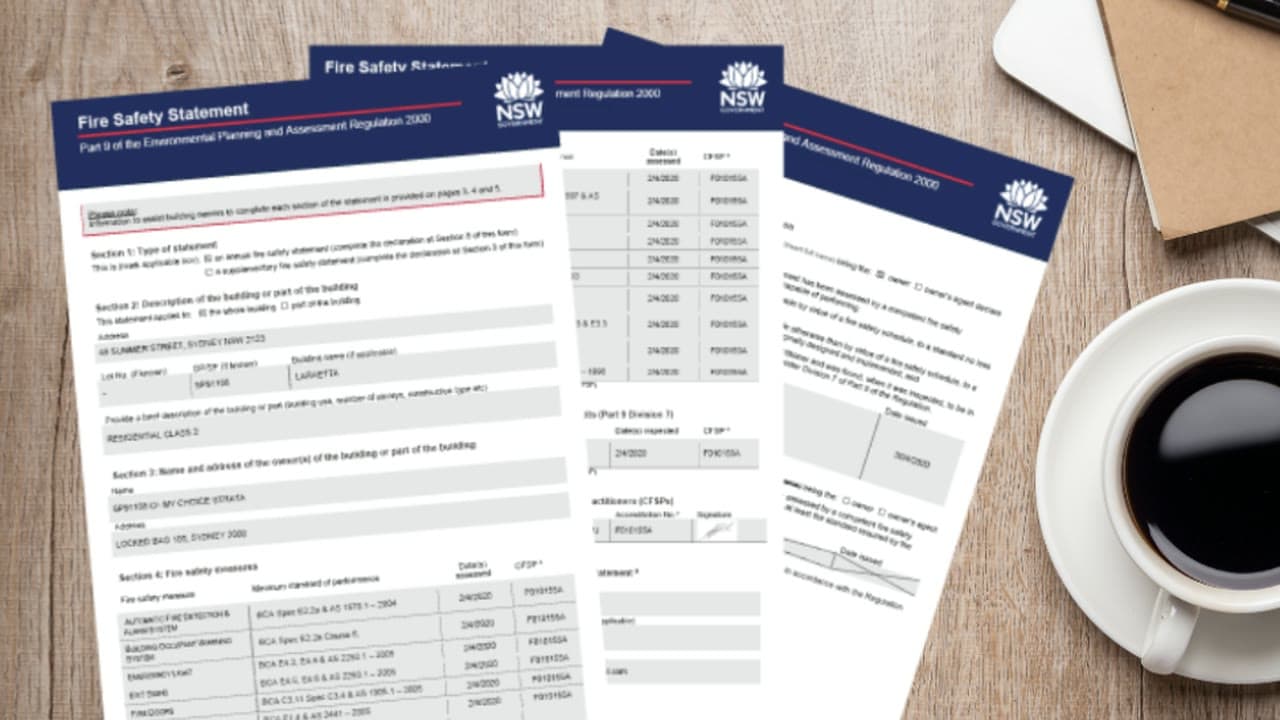
| NSW | Annual Fire Safety Statement (plus supplementary statements for critical measures) | Owner or authorised agent, relying on an accredited practitioner (fire safety) | Every 12 months; measures assessed in the 3 months before issue | Council and Fire and Rescue NSW; displayed in the building | AS 1851 records, rectified defects, and the assessment if you hold the right accreditation |
| VIC | Annual Essential Safety Measures Report (AESMR) | Owner, or an agent with written authority | Within 28 days before the occupancy permit or determination anniversary, or 13 June | Kept by the owner; produced within 24 hours of a request | Maintenance records, names of everyone who did the work, the standard each measure is serviced to |
| QLD | Occupier statement | Occupier (owner if there is no occupier) | Within one year of occupation, then yearly | Queensland Fire Department within 10 business days; copy kept 2 years | Records with your licence number, critical defect notices within 24 hours |
| SA | ESP maintenance verification (Form 3) | Owner, on the approved form | Within 60 business days after the end of each calendar year | Council (State Planning Commission outside council areas) | Annual testing to MBS 002 and the Form 1, and a position on open defects |
| WA | None found | Not applicable | Continuing duty | Owner keeps records | Records showing each measure can perform to its relevant building standard |
| TAS | None found under the Building Act 2016 | Not applicable | Per the approved schedule of maintenance | Records produced on request | Maintenance to the schedule and the Director’s Determination |
| ACT | None; fire safety schedule and records | Not applicable | Continuing duty | Records to ACT Fire & Rescue within 48 hours of a request | AS 1851 records, yearly condition reports, critical defect notices |
| NT | None; maintenance records | Not applicable | Continuing duty | Records to NT Fire and Rescue Service within 48 hours of a request | AS 1851 records, yearly condition reports |
New South Wales: the Annual Fire Safety Statement
NSW runs the most formal regime in the country. It sits in the Environmental Planning and Assessment (Development Certification and Fire Safety) Regulation 2021, and the full detail is in our Annual Fire Safety Statement guide. The essentials:
- The document: an annual fire safety statement on the form approved by the Planning Secretary, declaring that an accredited practitioner (fire safety) has assessed, inspected and verified the performance of each essential fire safety measure, and has inspected the building’s exit systems.
- Who signs: the owner, or an agent with prior authority. The NSW Department of Planning is explicit that the accredited practitioner who did the assessment, and their employer, employee or direct associate, must not make the owner’s declaration.
- When: each year, within 12 months of the previous statement, with each measure assessed within the 3 months before the statement is issued.
- Where it goes: a copy to the local council, a copy to the Commissioner of Fire and Rescue NSW, and a copy displayed prominently in the building.
- Critical fire safety measures listed on the schedule need supplementary statements at the shorter interval the schedule sets.
What you supply: the routine AS 1851 servicing that keeps the measures able to pass assessment, fast rectification of defects (a measure that does not perform can’t be certified), and, if your technicians hold the relevant accreditation class, the assessment itself. That assessment is a separate, accredited judgement, not a routine service under another name, and it has to fall inside the 3 month window.
Victoria: Essential Safety Measures and the AESMR
Victoria’s regime is Part 15 of the Building Regulations 2018. Our AESMR guide goes through the prescribed form line by line; here is the summary.
- The document: the Annual Essential Safety Measures Report, on the prescribed form.
- Who signs: the owner. The Building and Plumbing Commission notes the owner may authorise an agent, such as a specialist maintenance contractor, to complete it, and the Building Act requires that authority to be in writing.
- When: within 28 days before each anniversary of the date the first occupancy permit or maintenance determination was issued. A building with neither has a fixed date: within 28 days before 13 June.
- Where it goes: nowhere. The owner keeps it, along with the maintenance records, and must make the reports and records available within 24 hours of a request by the municipal building surveyor or the chief officer of the fire authority.
- What it covers: the measures listed on the occupancy permit or maintenance determination, maintained to the frequency and standard those documents specify.
What you supply: maintenance records for every measure, the name and company of everyone who worked on them in the last 12 months (the form asks for it), and which edition of AS 1851 each measure is maintained to, since many Victorian permits still name the 2005 edition. Because nothing is lodged, the first check may be an inspection on 24 hours’ notice.
Queensland: the occupier statement
Queensland’s regime comes from the Fire Services Act 1990, the Building Fire Safety Regulation 2008 and Queensland Development Code MP 6.1. Our occupier statement guide has the detail.
- The document: an occupier statement about the maintenance of each prescribed fire safety installation. MP 6.1 Schedule 2 provides a sample form.
- Who signs: the occupier. If there is no occupier, the owner. In multi tenancy buildings, tenants are usually responsible for their tenancy and the building manager for common areas.
- When: within one year of taking up occupation, then yearly from the last statement. Two tenancies in the same building can have different due dates.
- Where it goes: section 55A of the Building Fire Safety Regulation requires the occupier to give a copy to the Commissioner of the Queensland Fire Department within 10 business days after it was due, and to keep a copy with the record of maintenance for 2 years.
What you supply: Queensland’s regulation talks to the contractor directly. Records of maintenance must carry your name and licence number, a statement that the work complied with MP 6.1, and the results. You must give the occupier a critical defect notice within 24 hours. And repairs shown in the record must be done within one month unless the occupier has a reasonable excuse, so slow quoting becomes your client’s compliance problem.
South Australia: Essential Safety Provisions and Form 3
South Australia calls them essential safety provisions (ESPs). The rules are in regulation 94 of the Planning, Development and Infrastructure (General) Regulations 2017, and the maintenance routines are set by Ministerial Building Standard MBS 002, Maintaining the performance of essential safety provisions (version 3, May 2023).
The three forms
- Form 1, the schedule of ESPs: issued by the relevant authority, usually at building consent, listing each ESP and its maintenance and testing standard.
- Form 2, the ESP compliance certificate: signed by the installer when each ESP is installed.
- Form 3, the ESP maintenance verification: the annual proof, provided by the owner to council.
The annual obligation
- The owner must not use or permit the use of the building unless maintenance and testing have been carried out on each ESP on an annual basis, by calendar year, to MBS 002.
- The owner must give council the Form 3 verification no later than 60 business days after the end of each calendar year. Outside council areas it goes to the State Planning Commission.
- It confirms the work was done and that no defects reduce an ESP’s effectiveness, or that steps are being taken to rectify them.
- Exempt from the annual verification: Class 1b buildings, and Class 3 to 8 and 9b buildings of no more than 2 storeys and 500 m², unless council requires it (for example for a performance solution or after a fire safety notice).
- On request, the owner must produce written proof of the maintenance and testing for up to the 2 preceding calendar years within 48 hours.
Enforcement runs through Building Fire Safety Committees, the appropriate authority under section 157 of the Planning, Development and Infrastructure Act 2016, which can inspect buildings and serve fire safety notices on owners.
What you supply: maintenance and testing to the routines on the building’s Form 1 (MBS 002 lets owners of older buildings apply for a new Form 1 to move to AS 1851 routines), records and condition reports, and a written position on every open defect before the deadline. MBS 002 uses AS 1851’s critical and non-critical defect definitions, so your classifications flow straight into the owner’s verification. And because SA runs on the calendar year, every SA client falls due in the same window: plan the December and January workload in October.
Western Australia: a maintenance duty, not a statement
Western Australia’s core provision is regulation 48A of the Building Regulations 2012, Maintenance of buildings. It requires the owner of an existing Class 2 to Class 9 building to ensure the safety measures in each part of the building are capable of performing to the standard in the relevant building standards for that part. The penalty is a fine of $5,000.
- Safety measures are defined broadly, from fire integrity, egress and lighting to fire services, detection, occupant warning, air handling and standby power.
- The relevant building standards are the Building Code edition named in the certificate of design compliance for the most recent building permit, or earlier requirements for older buildings.
- We could not find a statewide annual statement, report or lodgement requirement in the regulations.
What you supply: because the legal test is capability to perform, the owner’s evidence is your service history, with AS 1851 as the practical benchmark. Other requirements can apply to particular building types or approvals, so ask the client whether anything applies beyond regulation 48A, and check for performance solutions with their own maintenance requirements.
Tasmania: the schedule of maintenance
Tasmania regulates maintenance of essential building services under Part 14 of the Building Act 2016, Part 7 of the Building Regulations 2016, and the Director’s Maintenance of Prescribed Essential Building Services Determination.
- The responsible owner (which includes an occupier with a contractual responsibility to maintain the services, and a strata body corporate) must have a schedule of maintenance prepared and approved by a building surveyor, review it at the specified period, and comply with it.
- For new work the building surveyor issues it on Approved Form 46; owners of older buildings engage a building surveyor to create one.
- The Determination sets the frequencies. For fire integrity, fire doors, fire services and similar items, most entries simply say as prescribed in AS 1851-2012; exit signs and emergency lighting are every 6 months to AS/NZS 2293.2:1995.
- The responsible owner or occupier must keep the specified maintenance records and provide them to an authorised officer, or the Chief Officer under the Fire Service Act 1979, on request.
- There is no direct licensing of routine maintenance, but the Determination says technical fire protection work needs a contractor with specialist skills.
You will still hear about Tasmania’s annual maintenance statement. That form belonged to the repealed Building Act 2000, and we could not find an equivalent in the current Act, Regulations or Determination. If a client’s schedule asks for one, confirm the requirement with the building surveyor or Building Standards Tasmania.
Australian Capital Territory: FSG-05
In the ACT the duty sits in the Emergencies Act 2004, and ACT Fire & Rescue explains how it applies in Fire Safety Guideline FSG-05, Maintenance of fire protection systems and equipment (August 2023), which covers Class 2 to 9 buildings.
- Section 95 makes it an offence for the occupier not to maintain a fire appliance to a proper maintenance standard. The Act names AS 1851 and AS/NZS 2293.2 as in force from time to time, or a standard approved for the appliance as part of a building approval.
- FSG-05 expects a fire safety schedule listing every system, its design standard and installation date (it includes a template).
- Records, including the fire safety schedule, logbooks, summary records and yearly condition reports, must be available to ACT Fire & Rescue within 48 hours of a request.
- Defects follow the AS 1851 reporting timeframes, and ACT Fire & Rescue must be notified in writing of all critical defects as soon as practicable after they are identified.
- Owners and maintenance providers are expected to make a concerted effort to compile baseline data where AS 1851 needs it.
What you supply: AS 1851 records, the yearly condition report, help compiling the fire safety schedule and baseline data, and the critical defect notification. There is no annual statement, but the 48 hour rule means the records have to be retrievable all year.
Northern Territory: prescribed buildings and records
In the NT the maintenance obligation is in the Fire and Emergency Act and Regulations rather than the building legislation. The NT Fire and Rescue Service advisory note, Maintenance of building fire safety measures, sets out how it applies.
- Regulation 11(6)(a) of the Fire and Emergency Regulations requires the owner of a prescribed building (listed in Schedule 2) to ensure fire alarms and other warning apparatus, exit lights, emergency lighting and fire fighting equipment are maintained in accordance with relevant standards.
- The advisory note lists AS 1851-2012 for most measures and AS/NZS 2293.2 for emergency lighting and exit signs, with performance solution requirements taking priority where they exist.
- The owner must keep maintenance records (logbooks, or tags and labels with hard copy summaries) available to NTFRS within 48 hours of a request, identifying each measure, dates, pass or fail criteria, defects and who did the work.
- Section 27A of the Fire and Emergency Act allows prescribed buildings to be inspected regularly.
What you supply: records that meet that list, yearly condition reports in the AS 1851 format, and defect reporting to the AS 1851 timeframes. NTFRS recognises units of competency and FPAS accreditation as evidence of competence, so expect owners to ask for it.
What is the same everywhere
- The duty sits with the owner or occupier, never the contractor, but every owner discharges it using your records.
- AS 1851 is the routine service benchmark almost everywhere, though some NSW and Victorian schedules name an older edition.
- The building’s own documents decide what is maintained, and a performance solution’s maintenance requirements apply even where AS 1851 differs.
- Records have to be producible fast: 24 hours in Victoria, 48 hours in SA (covering up to two calendar years), the ACT and the NT, and on request in Queensland and Tasmania.
- Critical defects are reported fast: AS 1851 sets the baseline, Queensland adds a 24 hour statutory notice, and the ACT wants the fire service told in writing.
Working across borders
The hard part of a national portfolio is running every state out of one system without the rules bleeding into each other.
- Record the jurisdiction and the governing document on every site. A building’s obligations come from its own fire safety schedule, permit or Form 1, not from the state in general.
- Record the maintenance standard and edition per measure. A Victorian building on AS 1851-2005 and an SA building on an old Form 1 need different records.
- Build report templates for the strictest jurisdiction you work in. Records with the technician’s licence number, a compliance statement and pass or fail results work in Queensland and do no harm anywhere else.
- Know who signs. In Queensland it’s the occupier, so one building can have several. In NSW the person who assessed a measure can’t sign the owner’s declaration.
- Check licensing and accreditation per state: NSW accredited practitioners for assessments, QBCC licensing in Queensland, and different competency expectations elsewhere.
- Don’t invent a statement. Where the law asks for none, give the client a yearly condition report and clean records instead.
Setting up schedules so due dates aren’t missed
Every regime has a date that is not your service date. Schedule backwards from the compliance date, not forwards from the last visit.
| Jurisdiction | Anchor date to record | Work back from it |
|---|---|---|
| NSW | Date of the last statement, plus any supplementary intervals | Assessments inside the 3 month window, with time to rectify and reassess |
| VIC | Permit or determination anniversary, or 13 June | Annual work and reports finished before the 28 day window opens |
| QLD | Each occupier’s occupation date, then their last statement | Annual work and records issued before the due date |
| SA | End of the calendar year, then 60 business days | Testing done by December, defect positions written up in January |
| WA, TAS, ACT, NT | Your service anniversaries and the building’s schedule | Yearly condition report on time; records ready within 48 hours |
- Put the compliance date on the site record next to the AS 1851 frequencies, so whoever schedules sees both.
- Land the annual and five yearly activities well before the compliance date. That is where defects surface, and defects take time to quote, approve and fix.
- Treat open defects as a compliance risk, not just a sales opportunity: an NSW measure that does not perform can’t be certified, and a Queensland repair has a one month clock.
- Send an annual summary before the client’s window opens: every measure, what was done, open defects, and who did the work.
Frequently asked questions
Which states require an annual fire safety statement?
NSW (the Annual Fire Safety Statement), Victoria (the AESMR, kept rather than lodged) and Queensland (the occupier statement). South Australia requires an annual Form 3 verification to council for non-exempt buildings. We could not find a statewide annual statement in WA, Tasmania, the ACT or the NT, where the obligation is to maintain and keep records.
Can the fire contractor sign the statement for the owner?
It depends on the state. In Victoria an agent with the owner’s written authority can prepare and sign the AESMR, and the regulator names specialist maintenance contractors as an example. In NSW the accredited practitioner who assessed a measure, and their employer, employees and direct associates, must not make the owner’s declaration. In Queensland it is the occupier’s statement. Check the form and the regulator’s guidance before agreeing to sign anything on a client’s behalf.
Is AS 1851 mandatory in every state?
Not uniformly. It is named in the ACT legislation, specified for most fire items in the Tasmanian Determination and the NT advisory note, set by MP 6.1 in Queensland and referenced in SA’s MBS 002. In NSW and Victoria the standard is whatever the building’s schedule, permit or determination says: often AS 1851, sometimes an earlier edition or a performance solution’s own requirement.
We service a building in Western Australia. What paperwork does the owner need?
We could not find an annual form to lodge. Regulation 48A requires the owner to ensure the safety measures can perform to the relevant building standard, so what they need is evidence: a complete AS 1851 service history, yearly condition reports, and a clear record of defects and rectification.
Does South Australia’s Form 3 apply to every building?
No. Class 1a and Class 10 buildings are outside the ESP regime entirely, and Class 1b buildings plus Class 3 to 8 and 9b buildings with a rise of no more than two storeys and a floor area of no more than 500 m² are exempt from the annual verification, unless council requires it because of a performance solution or a fire safety notice. The duty to maintain and test annually still applies to them.
Sources and further reading
- Environmental Planning and Assessment (Development Certification and Fire Safety) Regulation 2021 (NSW)
- Fire safety statements: frequently asked questions, NSW Department of Planning and Environment
- Building Regulations 2018 (Vic)
- Essential safety measures, Building and Plumbing Commission (Vic)
- Building Fire Safety Regulation 2008 (Qld)
- Fire safety installations, Business Queensland
- Planning, Development and Infrastructure (General) Regulations 2017 (SA), regulation 94
- Ministerial Building Standard MBS 002: Maintaining the performance of essential safety provisions (May 2023), PlanSA
- Form 3: ESP maintenance certificate, PlanSA
- Building Regulations 2012 (WA), regulation 48A
- Building Act 2016 (Tas), Part 14
- Maintaining essential building services, Building Standards Tasmania
- Director’s Maintenance of Prescribed Essential Building Services Determination (Tas)
- FSG-05 Maintenance of fire protection systems and equipment, ACT Fire & Rescue (August 2023)
- Advisory note: Maintenance of building fire safety measures, NT Fire and Rescue Service
- Building inspection program fire safety checklist, NT Fire and Rescue Service